Our system will evaluate the answer based on this AI-generated description.
The image contains a line graph showing Twitter use by age group over 8 time points: 10/11, 11/01, 11/05, 11/08, 12/02, 12/08, 12/12, 13/05. Age groups are represented as 18-29, 30-49, 50-64, 65+. At 10/11, 18-29 usage is around 30%, 30-49 around 15%, 50-64 around 5%, 65+ just under 5%. At 11/01, 18-29 increases to just under 35%, 30-49 to just above 15%, 50-64 and 65+ remain steady. At 11/05, 18-29 drops to just above 30%, 30-49 rises to 20%, 50-64 to almost 10%, 65+ to almost 5%. At 11/08, 18-29 rises to just under 35%, 30-49 to just over 20%, 50-64 to just over 10%, 65+ to just over 5%. At 12/02, 18-29 drops to 30%, 30-49 drops to 15%, 50-64 rises to 12.5%, 65+ drops to 5%. At 12/08, 18-29 rises to almost 35%, 30-49 rises to 20%, 50-64 to almost 15%, 65+ to just over 5%. At 12/12, 18-29 drops to just above 30%, 30-49 drops to just over 15%, 50-64 rises to 15%, 65+ to just under 5%. At 13/05, 18-29 rises to just below 35%, 30-49 to just over 20%, 50-64 to just under 15%, 65+ remains steady.
Given the complexity of the image, the above description may not be entirely accurate.
Skyrocket your IELTS band score by 1-2 points in under a month with our premium plan!
Note: Both the topic and the answer were created by one of our users.
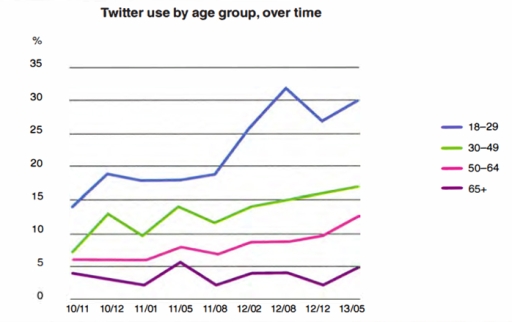
The line graph compares the proportion of Americans in four age groups who used Twitter between November 2010 and May 2013.
Overall, Twitter use rose across all age groups over the period, and the youngest group (18-29) remained the largest and showed the most pronounced growth. Older age bands increased more slowly and stayed considerably lower than the young adult cohort.
In November 2010, roughly 15% of 18-29-year-olds used Twitter; this figure climbed steadily and surged after early 2012 to reach about 30% by May 2013, with a peak slightly above 30% in late 2012. The 30-49 group began at around 8% and rose in a generally steady manner to roughly 15-16% by the end of the period. The 50-64 cohort showed moderate growth from approximately 4% to about 11%, with small fluctuations but a clear upward trend. Usage among those aged 65 and over remained the lowest: it hovered near 2-3% for much of the time before edging up to around 5% by May 2013.
Comparatively, the 18-29 group’s increase was both larger in absolute and relative terms than any other group, while the gap between the youngest and the oldest widened noticeably as Twitter gained popularity
Word Count: 198
