Our system will evaluate the answer based on this AI-generated description.
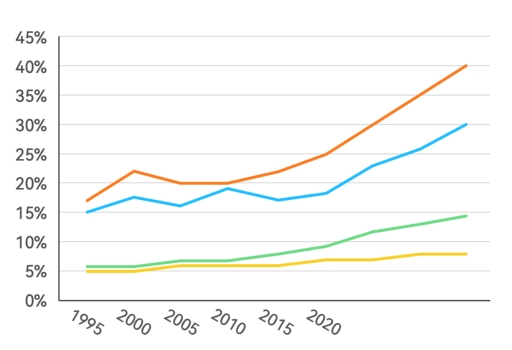
The image shows a line chart with four lines representing different data trends plotted against years 1995, 2000, 2005, 2010, 2015, 2020 on the x-axis and percentages ranging from 0% to 45% on the y-axis; the topmost line starts just above 15% in 1995, increases steadily to just under 25% by 2005, follows a steeper incline to almost 35% by 2010, and continues the rise to surpass 40% by 2020; the second-highest line begins just below 15% in 1995, experiences a slight dip to above 10% by 2000, ascends to just over 20% by 2010 and finishes near 30% by 2020; the third line, starting near 5%, progresses modestly to approach 10% in 2010 and concludes near 15% by 2020; the lowest line also commences at approximately 5%, shows a gradual incline to 10% by 2010, and reaches above 10% by 2020; no specific data points are labeled or marked on any lines.
Given the complexity of the image, the above description may not be entirely accurate.
Skyrocket your IELTS band score by 1-2 points in under a month with our premium plan!
Note: Both the topic and the answer were created by one of our users.
The line chart compares four age groups, 18-28, 29-39, 40-50, and 51-61, of people who do sport at a gym twice a week or more over the period from 1995 to now. Overall, the percentage of four groups experience an increase.
Starting at about 17% in 1995, the 29-39 group has keep its top rank and reaches 40% in the end of the graph. Similarly, the group of 18-28 has rose for 25 years while flucuating for years. Since 2020, it has witnessed a significant increase and achieve 30%.
On the other hand, the group of 40-50 and 51-61 do not grow dramatically. With a start of 6% in 1995, 40-50 group rises slowly to approximately 15%. While it almost increase by 150%, a rise that started at 5% in 1995 and then reach 7.5%, the 51-61 group has kept stay at the bottom of the four groups over the period.
Word Count: 151
