Our system will evaluate the answer based on this AI-generated description.
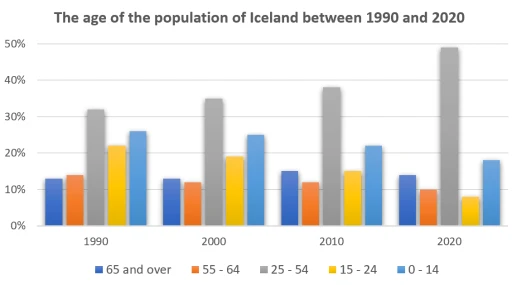
The image displays a bar graph demonstrating the age distribution of Iceland's population from 1990 to 2020 in five-year increments, with five age ranges represented by distinct colors. In 1990, ages 0-14 accounted for approximately 30%, ages 15-24 constituted about 15-20%, ages 25-54 comprised around 45%, ages 55-64 made up roughly 8%, and ages 65 and over occupied about 10%. In 2000, ages 0-14 decreased to about 25%, ages 15-24 remained around 15-20%, ages 25-54 increased to almost 50%, ages 55-64 stayed at 8%, and ages 65 and over rose to nearly 12%. In 2010, ages 0-14 further dropped to approximately 20%, ages 15-24 stayed around 15-20%, ages 25-54 decreased to about 45%, ages 55-64 increased to nearly 10%, and ages 65 and over climbed to almost 15%. Lastly, in 2020, ages 0-14 stayed at 20%, ages 15-24 remained around 15-20%, ages 25-54 decreased to roughly 40%, ages 55-64 increased to around 12%, and ages 65 and over rose to roughly 20%.
Given the complexity of the image, the above description may not be entirely accurate.
Skyrocket your IELTS band score by 1-2 points in under a month with our premium plan!
Note: Both the topic and the answer were created by one of our users.
The graph illustrates the age distribution of Iceland’s population from 1990 to 2020, divided into five distinct age ranges. Overall, the population trend shows a shift towards an ageing population.
In general, the graph highlights a noticeable decline in the proportion of younger ages, accompanied by a steady increase in the proportion of older ages.
On the one hand, the proportion of children and teenagers (ages 0-14) decreased steadily over the period, from approximately 30% in 1990 to around 20% in 2020. In contrast, the proportion of elderly citizens (ages 65 and over) more than doubled, from around 10% in 1990 to nearly 20% in 2020.
On the other hand, the proportion of the working-age population (ages 25-54) remained relatively stable, with some fluctuations. In 1990, this age group comprised around 45% of the population, increasing to almost 50% in 2000, before decreasing to roughly 40% in 2020. Meanwhile, the proportion of middle-aged citizens (ages 55-64) gradually increased, from approximately 8% in 1990 to around 12% in 2020.
Word Count: 168
