Our system will evaluate the answer based on this AI-generated description.
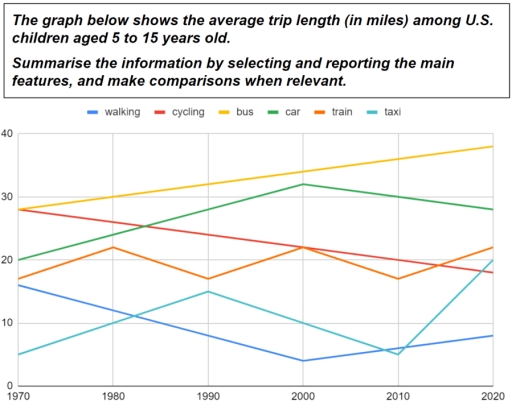
The image displays a line graph illustrating the average trip length in miles for U.S. children aged 5 to 15 over a period from 1970 to 2020, with measurements every decade. Data points for walking start from about 0.5 miles in 1970, peaking near 1 mile in 2010, and slightly decreasing to around 0.8 miles by 2020. Cycling begins at approximately 1.5 miles in 1970, rises to just below 2 miles in 1990, and maintains that length through 2020. The bus line starts around 10 miles in 1970, increases to roughly 15 miles by 1990, peaking at 20 miles in 2000, before it ends near 17 miles in 2020. Car travel starts near 3 miles in 1970, steadily climbs to just above 15 miles in 2000, and maintains this distance through 2020. The train line shows a starting point around 25 miles in 1970, falls to 20 miles in 1980, recovers to about 25 miles in 2000, decreases to slightly below 20 miles in 2010, before reaching almost 30 miles by 2020. Lastly, taxi usage begins around 3 miles in 1970, demonstrating a peak at approximately 10 miles in 2000 before slightly decreasing to 8 miles in 2020.
Given the complexity of the image, the above description may not be entirely accurate.
Skyrocket your IELTS band score by 1-2 points in under a month with our premium plan!
Note: Both the topic and the answer were created by one of our users.
The illustrated line graph represents how long the expedition length calculated by transportation on average across US adolescents aged 5 to 15 years old from 1970 to 2000 measured in miles.A general overview of data shows that kids who travelled by public transportation pointed a rising trend. Whereas, sustainable veichles remained becoming unpopular option among kids in US.
According to the data of public transportation, coaches holding the highest average trip length started at less than 30. It exhibited a gradual increase to more than 30, making it the most popular choice among children. Furthermore, automobiles in the US experienced around 30 in 2000 and there were decreased slightly by around 5. Fascinatingly, between 1980 and 1990 reported having the same point with cycling and hitting the peak in 2000.
Transitioning to friendly veichles, the average length of travelling by bicycle having decreased trend. There were dropped from 1970 to 1980 by 5. Following another decade, the trend was continued to decrease, dropping with about 1 of biking average expedition length. Moreover, walking by foot had the lowest number of average length, yet hitting the bottom at 5 in 2000, proving that walking became the least preferred option among pupils.
Word Count: 200
