Our system will evaluate the answer based on this AI-generated description.
The image shows a line graph of 15 year-olds with low literacy levels from 2000 to 2009 for Austria, Denmark, Ireland, and Sweden. In 2000, Austria started at about 18%, Denmark at 16%, Ireland at 12%, and Sweden at 10%. In 2003, Austria increased to about 19%, Denmark stayed the same, Ireland increased to about 13%, and Sweden increased to about 11%. In 2006, Austria increased dramatically to about 27%, Denmark increased to about 17%, Ireland increased to about 15%, and Sweden increased to about 12%. In 2009, Austria decreased to about 26%, Denmark increased to about 18%, Ireland increased to about 17%, and Sweden increased to about 14%. The y-axis represents the percentage of 15 year-olds with low literacy levels, while the x-axis represents the years. Each country is represented by a different colored line: Austria (blue), Denmark (purple), Ireland (yellow), and Sweden (green).
Given the complexity of the image, the above description may not be entirely accurate.
Skyrocket your IELTS band score by 1-2 points in under a month with our premium plan!
Note: Both the topic and the answer were created by one of our users.
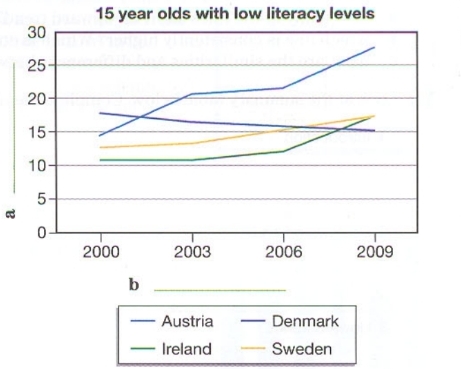
The line graph compares 15 year old teenagers which have bad literacy skills in 4 Europian countries(Austria, Denmark, Sweden and Ireland) by percentages from 2000 to 2009.
Overall, it can be seen that, the situation gotten worse during the given period except Denmark.
Starting with Austria, which stood at just below 15% in 2000, saw a significant growth to just over 20% in 2003. Then, there was still slight increase to 2006, from there to 2009, there was again huge increase, which peaked at approximately 28% which is highest out of all four countries. However, Denmark stood at just below 20% as it was highest in 2000 compared to other countries. But, Denmark experienced a loss from the start, then saw a little decrease change in 2003, and ended with 15%.
Unlike Denmark and Austira, Ireland and Sweden has similar characteristic as they started from the least spots with approximately 11% and 13%, respectively. Thougth, Ireland remain unchanged from 2000 to 2003, while Sweden witnessed a very little growth. From 2003 to 2009, they both experienced an increase, but Ireland with better increase stability. Furthermore, Ireland and Sweden ended with same percentage(approximately 17%).
Word Count: 193
