🔥 Today Only: Save 30% on Premium — Offer Ends Soon! - Upgrade Now!
Bar Chart

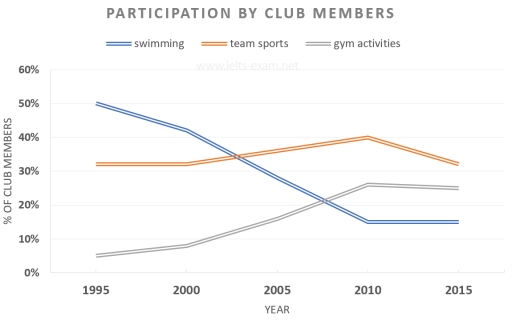
Band 7+: The graph shows the rates of participation in three different activities in a UK sports club between 1995 and 2015.

Image for topic: The graph shows the rates of participation in three different activities in a UK sports club between 1995 and 2015.
Our system will evaluate the answer based on this AI-generated description.
The image shows a line graph titled 'PARTICIPATION BY CLUB MEMBERS' with the Y-axis labeled '% OF CLUB MEMBERS' ranging from 0% to 60% in increments of 10%, and the X-axis labeled 'YEAR' with markers for 1995, 2000, 2005, 2010, 2015. Three lines represent swimming, team sports, and gym activities. In 1995, swimming starts at just below 50%, team sports at just above 30%, and gym activities at just over 20%. By 2000, swimming decreases to just over 40%, team sports increase to just over 40%, and gym activities rise to about 25%. In 2005, swimming continues to decline to around 35%, team sports drops to just above 30%, gym activities climb to just over 30%. By 2010, swimming reaches around 30%, team sports rises to above 35%, and gym activities peak at near 40%. In 2015, swimming stabilizes around 30%, team sports decreases slightly to just under 35%, and gym activities dip to just below 40%.
Given the complexity of the image, the above description may not be entirely accurate.
Note: Both the topic and the answer were created by one of our users.

This graph shows changes in the popularity of three different activities in a UK sports club over a period of 20 years.

In 1995 around 50% of club members participated in swimming, so this was clearly the most popular activity. However, this figure decreased steadily to 15% in 2010 and remained constant at this rate until 2015.

In contrast, 32% of members did team sports in 1995, and this rate reached a peak of 40% in 2010 before dropping to its former level. Participation rates for team sports increased overtook those for swimming and became the highest for all activities from 2005 to 2015.

Finally, participation in gym activities stood at only 5% in 1995, but this figure grew rapidly from 2000 to 2010, eventually reaching a peak of levelling off at around 25%, making gym the second most popular activity.

Overall, participation in swimming dropped considerably during the period. Team sports, however, remained popular, while participation in gym activities rose significantly over the period.

Word Count: 165

Answers On The Same Topic:

The graph shows the rates of participation in three different activities in a UK sports club between 1995 and 2015.

The line graph illustrates the proportion of people in the separated sports in a UK from 1995 to 2015. In 1995, the number of people who swim was 50%, which was the most popular activity in the UK, but it significantly dropped by around 20% by 2005. Those declined to around 15% in 2010 and […]

The graph shows the rates of participation in three different activities in a UK sports club between 1995 and 2015.

The graphs illustrates the percentage of competitors in swimming ,team sports and gym activities in a UK sports club in 1995 to 2015. Overall, the perticipator in swimming was decreased over the time, while the percentage of gym activites experienced a significant increased. The competitors of team sports remain almost stable in rest of the […]

The graph shows the rates of participation in three different activities in a UK sports club between 1995 and 2015.

The line graph compares the proportion of participation in three different forms of activities (swimming, team sports, and gym activities) in a UK sports club from 1995 to 2015. The units are measured in percentages. Overall, the most considerable decrease was seen in the figure for swimming, whereas the reverse was true for gym activities. […]

The graph shows the rates of participation in three different activities in a UK sports club between 1995 and 2015.

The Line graph illustrates thale data of participation by club members in three key activities like swimming, team sport,and gym activities for year between 1995 to 2015. Overall, in 1995 swimming had higher percentage of ther members other then two activities.however, it’s decline to least favorable activities in 2015.while gym activities show sudden growth. Firstly, […]

The graph shows the rates of participation in three different activities in a UK sports club between 1995 and 2015.

The given line graph illustrates the proportion of participation in three different activities in sports clubs in the United Kingdom (UK) from 1995 to 2015. Overall, the ratio of gym activities witnessed an upward trend. Meanwhile, the percentage of swimming decreased dramatically during these periods. The figure for swimming activities only dropped year by year. […]

See All

Other Topics:

The bar chart shows the number of cars per 1000 people in 5 countries in Europe in 2005, 2009 and 2015 compared with the European average.

The bar chart presents information about the number of cars per 1000 people, broken down by five countries and different years Overall, Iceland recorded the highest number of cars regardless of years while Latvia had the lowest number. Meanwhile, the figures for UK stood stable during the period,whereas Netherland experienced a gradual decline throughout period. […]

the percentage contribution of the IT and service industries to the GDP

The bar chart illustrates the proportion of Gross Domestic Product (GDP) generated by the IT and Service sectors in the United Kingdom between 1992 and 2000 Overall, both sectors grew over the given period. In addition, the IT industry contributed a higher percentage to the economy than the Service sector in every year. In 1992, […]

The bar chart gives information on the percentage of British people giving money to the charity by age range for the years 1990 and 2000.

The bar charts depicts on the percentage of the UK residents donete money to charity by age range group 18-65 in between 1990 and 2010. The figures are presented as porportion. Overall, the aged group of people 36-50 accounted for the highest rate of giving coins to charity throughoutthe period, whereas 18-25 aged group individuals […]

The bar chart below shows the divorce rates in two European countries from 2011 to 2015. Summarize the information by selecting and reporting the main features and make comparision where relevant

The bar chart illustrates the divorce rate in Finland and Sweden between 2011 and 2015. Overall,Sweden experienced a downward trend,while Finland showed an upward trend through the period.Although Finland intially had a lower rate but,in the end,it outraced Sweden.Both countries had some fluctuations. According to the table,in 2011,,he divorce rate in Sweden was 45%,approximately,By the […]

The bar chart below shows the divorce rates in two European countries from 2011 to 2015. Summarize the information by selecting and reporting the main features and make comparision where relevant

The bar chart illustrates the divorce rate in finland and sweden between 2011 and 2015. Overall,Sweden experienced a downward trend,while Finland showed an upward trend throught the period.Although finland intially had a lower rate but in the end,it outraced Sweden.Both countries had some fluctuations. According to the table,in 2011,the divorce rate of Sweden was 45%,approximately.By […]

the bar chart below shows the number of students who chose certain subjects in 2005

The bar illustrates the number of male and female students who chose eight different university subjects in 2005. Overall, Sciences and Social Sciences were by far the most popular subjects for male and female students, whereas languages for men and Mathematics for women were much less preferred. Starting with the most popular types of subjects. […]

See All
We have detected unusual activity on your device.
Please verify your identity to continue.
Note: This verification step won't sign you in. If you have a premium account, please log in to access the service as usual.
Google/Gmail Verification
Or verify using Email/Code
We've sent a verification code to:
youremail@gmail.com (Not your email?)
Enter it below to complete the verification process.
Ensure your email address is correct, your inbox is not full, and you check your spam folder. If no email arrives, consider using an alternative email.
You will need a Premium plan to perform your action!
Note: If you already have a premium account, please log in to access our services as usual.

Plans & Pricing

Our mission is to make quality education accessible for everyone.
However, to keep our hardworking team running and this service alive, we genuinely need your support!
By opting for a premium plan, not only do you sustain us in achieving the mission, but you also unlock advanced features to enrich your learning experience.

Free

For learners who aren't pressed for time

What's included on Free
100+ Cambridge IELTS Tests
Instant IELTS Writing Task 1 & 2 Evaluation (2 times/month)
Instant IELTS Speaking Part 1, 2, & 3 Evaluation (2 times/month)
Instant IELTS Writing Task 1 & 2 Essay Generator (2 times/month)
500+ Dictation & Shadowing Exercises
100+ Pronunciation Exercises
Flashcards
Other Advanced Tools

Premium

For those serious about advancing their English proficiency, and for IELTS candidates aspiring to boost their band score by 1-2 points (especially in writing & speaking) in just 30 days or less

What's included on Premium
Save Your IELTS Test Progress & Analyze Mistakes By Question Type
Save Your Own Flashcard Sets & Use Them On Any Device
Unlock All Courses, IELTS Tests, Section & Part Practice
Unlimited AI Conversations
Unlimited AI Writing Enhancement Exercises
Unlimited IELTS Writing Task 1 & 2 Evaluation
Unlimited IELTS Speaking Part 1, 2, & 3 Evaluation
Checked Answers Will Not Be Published
Unlimited IELTS Writing Task 1 & 2 Essay Generator
Unlimited IELTS Speaking Part 1, 2, & 3 Sample Generator
Unlimited Usage Of Advanced Tools & AI Features
Priority Support within 24h (12-month plan only)

Due to the nature of our service and the provided free trials, payments are non-refundable.