🔥 Today Only: Save 30% on Premium — Offer Ends Soon! - Upgrade Now!
Multiple Graphs

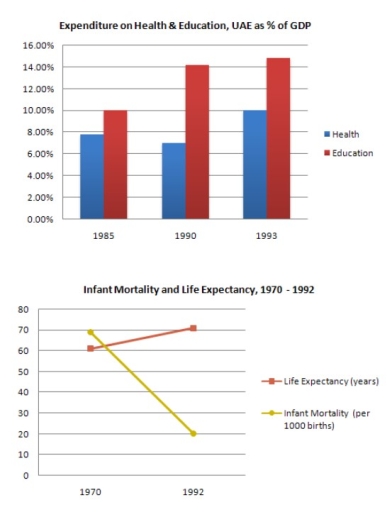
Band 8+: The graphs below show the Expenditure on Health & Education, UAE as percentages of GDP and Infant mortality and life expectancy.

Image for topic: The graphs below show the Expenditure on Health & Education, UAE as percentages of GDP and Infant mortality and life expectancy.
Our system will evaluate the answer based on this AI-generated description.
The image contains two graphs; the top graph is a bar chart labeled 'Expenditure on Health & Education, UAE as % of GDP' and has three pairs of bars representing the years 1985, 1990, and 1993. In 1985, health expenditure was around 4.0%, and education was approximately 12.0%. In 1990, health was just under 6.0%, and education was around 8.0%. In 1993, health was about 6.5%, and education was approximately 13.5%. The bottom graph is a line chart labeled 'Infant Mortality and Life Expectancy, 1970 - 1992' with two lines, one for life expectancy (years) and the other for infant mortality (per 1000 births). In 1970, life expectancy was about 65 years, and infant mortality was roughly 80 per 1000 births. By 1992, life expectancy had increased to just under 75 years, whereas infant mortality had decreased significantly to about 20 per 1000 births.
Given the complexity of the image, the above description may not be entirely accurate.
Note: Both the topic and the answer were created by one of our users.

The graphs illustrate the percentage of GDP spent on health and education in the UAE between 1985 and 1993, as well as data on infant mortality (measured per 1,000 births) and duration of human lifespan (measured in years) from 1970 to 1992.

In general, a higher percentage of expenditure is allocated to education than to healthcare. Meanwhile, infant mortality declined significantly, whereas human lifespan showed a steady rise.

Regarding the expenditure, the proportion of education increased significantly and consistently, from 10% in 1985 to roughly 15% in 1993 during the time frame. A similar pattern was also shown in healthcare, in which the figure generally increased. However, there was a fluctuating trend between 1990 and 1993, with the percentage dropping from well below 8% to about 7% before rising back to approximately 10% by the end of the period.

Turning to the second graph, infant mortality declined markedly from 1970 to 1992 (about 70 to around 20 per 1,000 births). By contrast, human lifespan rose steadily, standing at 60 years then increasing to 70 years over the same period.

Word Count: 179

Answers On The Same Topic:

The graphs below show the Expenditure on Health & Education, UAE as percentages of GDP and Infant mortality and life expectancy.

raphs show information about government budget on health and education, and number of infant mortality and life expectancy from 1970 to 1992. The first graph includes three years – 1985, 1990, 1993 in UAE. Health was funding almost 8 percent of GDP in 1985. This rate was decreased to 7 % in five years. The […]

The graphs below show the Expenditure on Health & Education, UAE as percentages of GDP and Infant mortality and life expectancy.

The graphs show the percentage of GDP spent on health and education in the UAE between 1985 and 1993, and data on life expectancy and infant mortality from 1970 to 1992. Overall, spending on both sectors increased over time, and this was followed by a longer life expectancy and lower infant mortality. In 1985, around […]

The graphs below show the Expenditure on Health & Education, UAE as percentages of GDP and Infant mortality and life expectancy.

The bar chart given illustrates the proportions of expenditure on health and education in the UAE over a seven-year period, from 1985 to 1993, while the line graph elucidates the numbers of infant mortality and life expectancy over a twenty-two-year period, ending in 1992 . Viewed together, there appears to be a relationship between the […]

The graphs below show the Expenditure on Health & Education, UAE as percentages of GDP and Infant mortality and life expectancy.

The provided bar chart illustrates how much money UAE’s people spend on health and education over 8 years, from 1985 to 1993, measured in percentage of GDP and the second graph demonstrates the number of infant mortality rates per 1000 births and life expectancy per years from 1970 to 1992. Overall, it is apparent that […]

See All

Other Topics:

The six pie charts illustrate the proportion of water used for three different purposes—agricultural, industrial, and domestic

The given pie chart illustrates the proportion of water utilized for distinct aim agriculture, domestic, and industrial use in six areas of the world. Overall, the water consumption dominates the agriculture use in north America and Europe, whereas, industrial water usage is higher in other countries like south America, Africa, central Asia and south east […]

the chart and table below give information about online shopping by Australia and New Zealand customers in 2012

the chart and table illustrate data based on online shopping among two difference countries Australian and New Zealand consumers in 2012 overall, the charts compared 3 functions in other respects overseas websites only accounted for the highest while Both overseas and local websites in the bottom. Simultaneously, the table gives some data about these reasons […]

The charts below show the population size and life expectancy for five European countries in 1914 and 2014. Summarise the information by selecting and reporting the main features, and make comparisons where relevant.

The bar chart illustrates the population size and life expectancy figures in five different European countries, namely Spain, UK, Italy, France and Germany in the years 1914 and 2014. Overall, it is notable that population size in all countries experienced an increase, with Germany having the most and Spain the least. It also can be […]

The bar chart below shows the numbers of men and women attending various evening courses at an adult education centre in 2009. The pie chart gives information about the ages of these course participants

The bar chart below shows the numbers of men and women attending various evening courses at an adult education center in 2009, and the accompanying pie chart gives information about the ages of these course participants. Overall, the number of female participants was greater than males. Correspondingly to this, the language was the most popular […]

The two graphs show the main sources of energy in the USA in the 1980s and the 1990s. Write a report for a university lecturer describing the changes which occurred. Write at least 150 words.

The two pie charts illustrate the proportion of energy produced by five main sources in the years 1980 and 1990. Overall, in the given time frame, oil accounted for the lion’s share of energy production even though it experienced a decrease. Coal as well as nuclear power showed growth in energy production and its reverse […]

These pie charts describe the percentage of polluted ocean area in 1997 and 2007. The parts are measured in percents.

Both pie charts demonstrate the amount of wasted in several parts of sea by 1997 and 2007. Overall, pollutants from air is the highest while litter has declined to o%. By 1997, the most significantly polluted were from air which is shows by 30%, and continued to the second highest is marine that is 22%, […]

See All
We have detected unusual activity on your device.
Please verify your identity to continue.
Note: This verification step won't sign you in. If you have a premium account, please log in to access the service as usual.
Google/Gmail Verification
Or verify using Email/Code
We've sent a verification code to:
youremail@gmail.com (Not your email?)
Enter it below to complete the verification process.
Ensure your email address is correct, your inbox is not full, and you check your spam folder. If no email arrives, consider using an alternative email.
You will need a Premium plan to perform your action!
Note: If you already have a premium account, please log in to access our services as usual.

Plans & Pricing

Our mission is to make quality education accessible for everyone.
However, to keep our hardworking team running and this service alive, we genuinely need your support!
By opting for a premium plan, not only do you sustain us in achieving the mission, but you also unlock advanced features to enrich your learning experience.

Free

For learners who aren't pressed for time

What's included on Free
100+ Cambridge IELTS Tests
Instant IELTS Writing Task 1 & 2 Evaluation (2 times/month)
Instant IELTS Speaking Part 1, 2, & 3 Evaluation (2 times/month)
Instant IELTS Writing Task 1 & 2 Essay Generator (2 times/month)
500+ Dictation & Shadowing Exercises
100+ Pronunciation Exercises
Flashcards
Other Advanced Tools

Premium

For those serious about advancing their English proficiency, and for IELTS candidates aspiring to boost their band score by 1-2 points (especially in writing & speaking) in just 30 days or less

What's included on Premium
Save Your IELTS Test Progress & Analyze Mistakes By Question Type
Save Your Own Flashcard Sets & Use Them On Any Device
Unlock All Courses, IELTS Tests, Section & Part Practice
Unlimited AI Conversations
Unlimited AI Writing Enhancement Exercises
Unlimited IELTS Writing Task 1 & 2 Evaluation
Unlimited IELTS Speaking Part 1, 2, & 3 Evaluation
Checked Answers Will Not Be Published
Unlimited IELTS Writing Task 1 & 2 Essay Generator
Unlimited IELTS Speaking Part 1, 2, & 3 Sample Generator
Unlimited Usage Of Advanced Tools & AI Features
Priority Support within 24h (12-month plan only)

Due to the nature of our service and the provided free trials, payments are non-refundable.