Our system will evaluate the answer based on this AI-generated description.
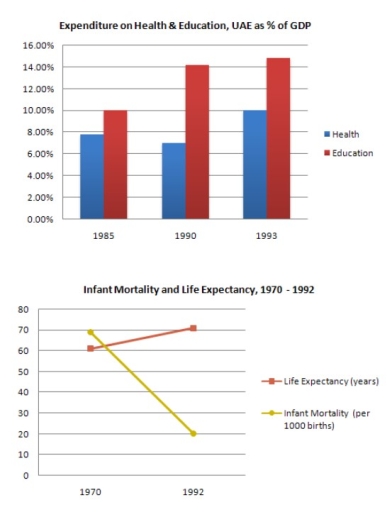
The image contains two graphs; the top graph is a bar chart labeled 'Expenditure on Health & Education, UAE as % of GDP' and has three pairs of bars representing the years 1985, 1990, and 1993. In 1985, health expenditure was around 4.0%, and education was approximately 12.0%. In 1990, health was just under 6.0%, and education was around 8.0%. In 1993, health was about 6.5%, and education was approximately 13.5%. The bottom graph is a line chart labeled 'Infant Mortality and Life Expectancy, 1970 - 1992' with two lines, one for life expectancy (years) and the other for infant mortality (per 1000 births). In 1970, life expectancy was about 65 years, and infant mortality was roughly 80 per 1000 births. By 1992, life expectancy had increased to just under 75 years, whereas infant mortality had decreased significantly to about 20 per 1000 births.
Given the complexity of the image, the above description may not be entirely accurate.
Skyrocket your IELTS band score by 1-2 points in under a month with our premium plan!
Note: Both the topic and the answer were created by one of our users.
The graphs show the percentage of GDP spent on health and education in the UAE between 1985 and 1993, and data on life expectancy and infant mortality from 1970 to 1992.
Overall, spending on both sectors increased over time, and this was followed by a longer life expectancy and lower infant mortality.
In 1985, around 8% of GDP was spent on education and 6% on health. By 1993, both figures had risen, with education reaching almost 15% and health about 10%.
Between 1970 and 1992, life expectancy increased slightly from around 60 to 72 years. In contrast, infant mortality dropped dramatically from about 70 deaths per 1,000 births to only 20, showing clear improvement in living standards.
Word Count: 117
