🔥 Today Only: Save 30% on Premium — Offer Ends Soon! - Upgrade Now!
Line Graph

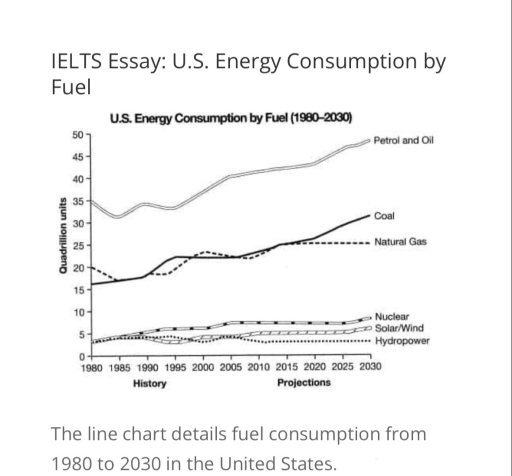
Band 5+: The line chart details fuel consumption from 1980 to 2030 in the United States.

Image for topic: The line chart details fuel consumption from 1980 to 2030 in the United States.
Our system will evaluate the answer based on this AI-generated description.
The image depicts a line chart titled "U.S. Energy Consumption by Fuel (1980-2030)" with six labeled lines representing "Petrol and Oil," "Coal," "Natural Gas," "Nuclear," "Solar/Wind," and "Hydropower." The chart's X-axis spans from 1980 to 2030, with the years 1985, 1995, 2005, 2010, 2015, 2020, and 2025 marked. The Y-axis measures quadrillion units from 0 to 50, in increments of 5. "Petrol and Oil" begins at approximately 30 quadrillion units in 1980, peaking near 45 in 2010 and projected to rise slightly above that by 2030. "Coal" starts near 15, peaks at 25 around 2005, and is projected to decline to just above 20. "Natural Gas" begins below 15, surpasses "Coal" near 2010 just under 25, and is expected to reach 30 by 2030. "Nuclear" maintains a steady rise from 5 in 1980 to a projected 10 in 2030. "Solar/Wind" starts at 0, shows a sharp increase after 2010, and is projected to surpass "Nuclear" by 2030, reaching approximately 15. "Hydropower" hovers consistently around 5 quadrillion units throughout the timeline.
Given the complexity of the image, the above description may not be entirely accurate.
Note: Both the topic and the answer were created by one of our users.

The given chart provides the amount of expenditure power of fuel in six categories between 1980 and 2030 in U. S. The data is measured in quadrillion.

In general, it was obvious that petrol and oil had the highest rates of consumption, followed by coal and natural gas that had similar trends, and the last for nuclear, solar/wind, and hydropower that were the least. However, all type of energies experienced an increase, except hydropower which fluctuated.

According to the chart, in the beginingof 1960, petrol an oil had around 35 units and it fluctuated in the next 15 years then increased significantly, reached its peak at mereky 50. For the coal and natural gas, at first coal had less figures than natural gas with roughly 15 and 20 proportion, respectively, but they grew slightly and had the same amount of utilization in 2015. Moreover, over a fifteen-year of period, coal still climbed to 30 by 2030, while natural gas kept at the same number with 25 of rates.

Turning to the next data, nuclear, solar/wind, and hydropower started from the same number, merely 3 quadrillion in 1980. Furthermore, nuclear increased gradually for the given period with about 5 difference, on the other hand remaining energies fluctuated and level off in 2015 at about 3 quadrillion for hydropower and just above 5 quadrillion for solar/wind.

Word Count: 224

Answers On The Same Topic:

The line chart details fuel consumption from 1980 to 2030 in the United States.

The provided line chart compares the consumption of different types of fuel from 1980 as well as predict the quantity usage for year 2030. Overall, petrol and oil has been predominately used over years while coal and natural gas are used mildly. There is less consumption of fuel i.e. Nuclear, Solar/Wind and Hydropower. Although there […]

The line chart details fuel consumption from 1980 to 2030 in the United States.

The provided chart gives the detail of US energy utilization by petroleum products from 1980 to 2030. Overall, except hydro power all sectors of petroleum experienced an upward trend, along with coal, natural gas,petrol and oil having significant use as well nuclear and solar/wind have minor rise of consumption. As the Graph shows that the […]

The line chart details fuel consumption from 1980 to 2030 in the United States.

The line graph demonstrates the consumption of fuel between 1980 to 2030 in the United States Overall, it can be observed that the pertrol and oil have the most dominant number of fuel consumption, while the opposite was true for hydropower. In addition To begin with, In 1980, 35 Quadrillion units were generated using Petrol […]

The line chart details fuel consumption from 1980 to 2030 in the United States.

The chart illustrates data about energy use in USA from 1980 to 2030. Overall, the amount of petrol, oil and coal energy used predicted to grow significantly. In contrast, it is predicted that nuclear and hydropower energy consumption will remain relatively stable. To begin, between 1980 and 1995 pertol and oil energy consumption fluctuated between […]

The line chart details fuel consumption from 1980 to 2030 in the United States.

The line graph provides data from a 2008 report about usage of energy in the United States of America from 1980 with predictions up to 2030, measured in quadrillion units. Overall, it is clear that America mostly relied on fossil fuels, which will continue in the future. Petrol and Oil was the highest amount in […]

See All

Other Topics:

The graph below shows the average monthly temperatures in three major cities. summarize the information by selecting and reporting the main features and make comparison were relevant

The line graph gives information about temperature fluctuation in Paris, Boston and Melboume from in one year from January to the end of December. The most significant facts to emerge from the graph are that two cities temperature reached a high in August. Malboume has the opposite trend. Melboume is the warmest city in which […]

The given graph shows the past and projected figures of the government spending as a percentage of GDP for the years 2000 to 2025 in three areas. Summarise the information by selecting and reporting the main features and make comparisons where relevant.

The picture illustrates the three different projected figures of the government utilizing as a percentage of GDP from 2000 to 2025. As clearly seen, the rate of health has increased constantly greater than other proponents during the period. It started with exactly four percent at the beginning, and the rate rose until 2025. On the […]

the graph shows how londeners commute to work. Describe it

The line graph provides information about how people of London commute to work by utilizing distinct types of transport forms between 1970 and 2010. Overall, use of bus and car observed substantial decrease at its numbers, while subway followed an opposite trend. Similarly, to subway both bicycle and walking to the work rise modestly over […]

The line graph shows the percentage ofdifferent age groups ofcinema visitors in a particular country from 1978 to 2008.

The line graph provides information about the ratio of different age classifications of cinema watchers in a specific country between 1978 and 2008. The figures expressed in percentage. Overall, cinema movies were most popular among ages 14-24, whereas the age group above 50 were likely to visit cinemas. In detail, a fluctuation pattern can be […]

The graph below shows the number of students studying Computer Science at a university from 2010 to 2020.

The line graph illustrates the number of students who studied computer science at a university between 2010 and 2020. Overall it is clearly seen that, the number of computer science students increased over the period. Although there was a slight decline in 2016, the figure then rose sharply and reached its highest point in 2020. […]

The graph below gives information about the percentage of the population in four Asian countries living in c/tles from 1970 to 2020, with predictions for 2030 and 2040. Summarise the information by selecting and reporting the main features, and make comparisons where relevant.

The followig line chart illustrates the growth of indvisuals living in asian cites through 1970 to 2020, as well as, prections for the upcoming 20 years. As showen in the graph through out the years all populations in all of the Four cites climbed, but the highest being Indonesia and Malaysia( at about 60% and […]

See All
We have detected unusual activity on your device.
Please verify your identity to continue.
Note: This verification step won't sign you in. If you have a premium account, please log in to access the service as usual.
Google/Gmail Verification
Or verify using Email/Code
We've sent a verification code to:
youremail@gmail.com (Not your email?)
Enter it below to complete the verification process.
Ensure your email address is correct, your inbox is not full, and you check your spam folder. If no email arrives, consider using an alternative email.
You will need a Premium plan to perform your action!
Note: If you already have a premium account, please log in to access our services as usual.

Plans & Pricing

Our mission is to make quality education accessible for everyone.
However, to keep our hardworking team running and this service alive, we genuinely need your support!
By opting for a premium plan, not only do you sustain us in achieving the mission, but you also unlock advanced features to enrich your learning experience.

Free

For learners who aren't pressed for time

What's included on Free
100+ Cambridge IELTS Tests
Instant IELTS Writing Task 1 & 2 Evaluation (2 times/month)
Instant IELTS Speaking Part 1, 2, & 3 Evaluation (2 times/month)
Instant IELTS Writing Task 1 & 2 Essay Generator (2 times/month)
500+ Dictation & Shadowing Exercises
100+ Pronunciation Exercises
Flashcards
Other Advanced Tools

Premium

For those serious about advancing their English proficiency, and for IELTS candidates aspiring to boost their band score by 1-2 points (especially in writing & speaking) in just 30 days or less

What's included on Premium
Save Your IELTS Test Progress & Analyze Mistakes By Question Type
Save Your Own Flashcard Sets & Use Them On Any Device
Unlock All Courses, IELTS Tests, Section & Part Practice
Unlimited AI Conversations
Unlimited AI Writing Enhancement Exercises
Unlimited IELTS Writing Task 1 & 2 Evaluation
Unlimited IELTS Speaking Part 1, 2, & 3 Evaluation
Checked Answers Will Not Be Published
Unlimited IELTS Writing Task 1 & 2 Essay Generator
Unlimited IELTS Speaking Part 1, 2, & 3 Sample Generator
Unlimited Usage Of Advanced Tools & AI Features
Priority Support within 24h (12-month plan only)

Due to the nature of our service and the provided free trials, payments are non-refundable.