Our system will evaluate the answer based on this AI-generated description.
The image depicts a line chart titled "U.S. Energy Consumption by Fuel (1980-2030)" with six labeled lines representing "Petrol and Oil," "Coal," "Natural Gas," "Nuclear," "Solar/Wind," and "Hydropower." The chart's X-axis spans from 1980 to 2030, with the years 1985, 1995, 2005, 2010, 2015, 2020, and 2025 marked. The Y-axis measures quadrillion units from 0 to 50, in increments of 5. "Petrol and Oil" begins at approximately 30 quadrillion units in 1980, peaking near 45 in 2010 and projected to rise slightly above that by 2030. "Coal" starts near 15, peaks at 25 around 2005, and is projected to decline to just above 20. "Natural Gas" begins below 15, surpasses "Coal" near 2010 just under 25, and is expected to reach 30 by 2030. "Nuclear" maintains a steady rise from 5 in 1980 to a projected 10 in 2030. "Solar/Wind" starts at 0, shows a sharp increase after 2010, and is projected to surpass "Nuclear" by 2030, reaching approximately 15. "Hydropower" hovers consistently around 5 quadrillion units throughout the timeline.
Given the complexity of the image, the above description may not be entirely accurate.
Skyrocket your IELTS band score by 1-2 points in under a month with our premium plan!
Note: Both the topic and the answer were created by one of our users.
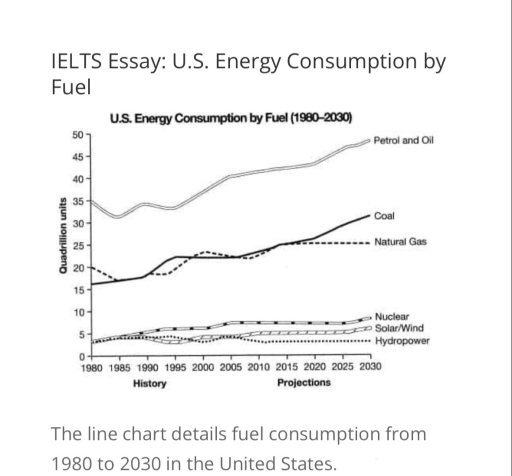
The line graph illustrates energy usage in the United States from 1980 and the predictions from 2009 up until 2030, due to the given information reporting back to 2008.
Overall, comparing the recorded six types of fuel, petrol and oil have been the most used sort and will continue to hold the lead position, expectedly, rising significantly to 50q over the given 50-year period. Moreover, fluctuating between second and third places are coal and natural gas, while coal is predicted to hit a high of 30 quad units surpassing natural gas, predominantly the second in 1980 with almost five units more than the former.
Far below are the remaining least used fuel kinds: nuclear, solar and wind, and hydropower. Reportedly having started at the same level in 1980 compromising of approximately 4 units. Meanwhile, nuclear, solar and wind are expected to increase slightly by the end of the presented years, in contrast, the hydropower rates have been going up and down until falling back to 4 units by 2010 and will predictably remain stable.
Word Count: 174
