Our system will evaluate the answer based on this AI-generated description.
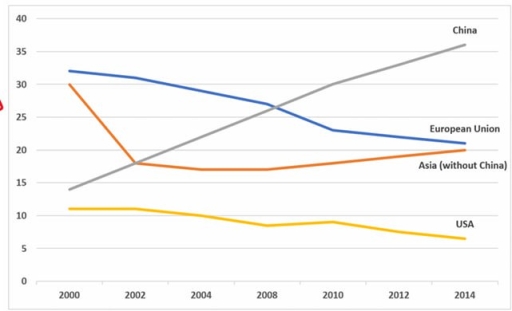
The image presents a line graph from 2000 to 2014 detailing numerical data for four entities: China, European Union, Asia (without China), and USA. In 2000, China starts at 8, European Union at 28, Asia (without China) at 26, and USA at 12. By 2002, China reaches 10, European Union at 26, Asia (without China) at 22, and USA at 11. In 2004, China's data moves to 15, European Union sits at 24, Asia (without China) at 19, and USA at 10. By 2006, China edges up to 19, European Union remains at 23, Asia (without China) remains steady at 19, and USA slightly lowers to 9. The 2008 data shows China at 23, European Union continuing at 23, Asia (without China) consistent at 19, USA at 9. In 2010, China advances to 27, European Union decreases to 21, Asia (without China) is steady at 19, and USA slightly dips to 8. By 2012, China records 32, European Union decreases to 20, Asia (without China) at 20, and USA charts 7. In 2014, China tops at 36, European Union stabilizes at 20, Asia (without China) at 21, and USA declines further to 6.
Given the complexity of the image, the above description may not be entirely accurate.
Skyrocket your IELTS band score by 1-2 points in under a month with our premium plan!
Note: Both the topic and the answer were created by one of our users.
The line graph below illustrates the consumption of three types of spreads between 1982 and 2007
Overall, there was a downward trend in margarine and butter, while low fat and reduced spreads experienced an upward trend over the period.
Low fat and reduced spread-s was not as popular as margarine and butter until 1996. The consumption of low fat and reduced spreads starting at 10 grams in 1996 and it was followed by a dramatic rise to approximately 80 grams in 2001, but a noticeable decrease was observed in the category in 2007
Margarine and butter especially butter was lovely product of consumers than other types of spreads. The consumption of butter experienced noticeable increase from approximately 140 grams to about 160 grams between 1981 and 1986, making it dominant one in 1986 compared to other categories. Until 2007 a dramatic decrease was seen in the consumption of butter whopping a 50 grams. The figure for spread in terms of margarine experienced noticeable decrease in the beginning of the year from approximately 90 grams to 80 grams between 1981 and 1986. After reaching 100 grams in 1991 the consumption of this category remained stable until 1996 and it was followed by a dramatic decrease from 100 grams to 40 grams between 1996 and 2007.
Word Count: 214
