Our system will evaluate the answer based on this AI-generated description.
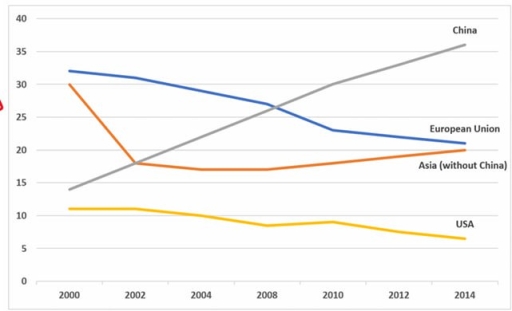
The image presents a line graph from 2000 to 2014 detailing numerical data for four entities: China, European Union, Asia (without China), and USA. In 2000, China starts at 8, European Union at 28, Asia (without China) at 26, and USA at 12. By 2002, China reaches 10, European Union at 26, Asia (without China) at 22, and USA at 11. In 2004, China's data moves to 15, European Union sits at 24, Asia (without China) at 19, and USA at 10. By 2006, China edges up to 19, European Union remains at 23, Asia (without China) remains steady at 19, and USA slightly lowers to 9. The 2008 data shows China at 23, European Union continuing at 23, Asia (without China) consistent at 19, USA at 9. In 2010, China advances to 27, European Union decreases to 21, Asia (without China) is steady at 19, and USA slightly dips to 8. By 2012, China records 32, European Union decreases to 20, Asia (without China) at 20, and USA charts 7. In 2014, China tops at 36, European Union stabilizes at 20, Asia (without China) at 21, and USA declines further to 6.
Given the complexity of the image, the above description may not be entirely accurate.
Skyrocket your IELTS band score by 1-2 points in under a month with our premium plan!
Note: Both the topic and the answer were created by one of our users.
The line chart depicts how many travellers visited a Caribbean island from 2010 to 2017, staying on cruise ships, on the island and the number of them totally. The data is measured in millions.
At first glance, it is readily obvious that Caribbean island witnessed a gradual growth in the number of visitors, despite minor declines. In the end of the period, more people opted for cruise ships rather than stayed on island.
According to the graph, in 2010, 1 million people visited the island, where the equal figure of visitors either stayed on ships or exlored the territory. After 2011, considerably more people began staying on the island (1.25 millions in 2012), while fewer of them opted for cruises (0.5 millions in 2012).
From 2012 to 2017, the number of visitors on a Caribbean island gradually increased, comprising 1.5 million of people by the end of period. In addition, the figure of travellers on transport showed exponential growth with the ultimate result of 2 million. Totally, 3.5 million of people visited a Caribbean island in 2017, which is 3.5 times more than 7 years ago.
Word Count: 186
