Our system will evaluate the answer based on this AI-generated description.
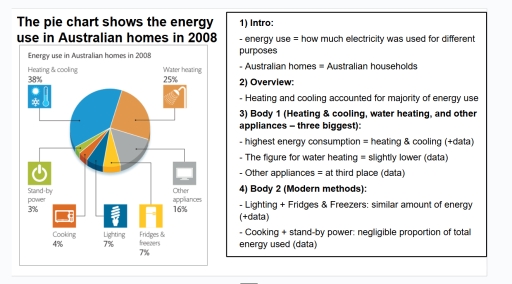
The image presents a pie chart titled 'The pie chart shows the energy use in Australian homes in 2008' and an accompanying outline. The chart, subtitled 'Energy use in Australian homes in 2008', shows percentages of energy use for various purposes: Heating & cooling 38%, Water heating 25%, Other appliances 16%, Lighting 7%, Fridges & freezers 7%, Cooking 4%, and Stand-by power 3%. The outline is structured as follows: 1) Intro: energy use = how much electricity was used for different purposes, Australian homes = Australian households. 2) Overview: Heating and cooling accounted for majority of energy use. 3) Body 1 (Heating & cooling, water heating, and other appliances -- three biggest): highest energy consumption = heating & cooling (+data), the figure for water heating = slightly lower (data), Other appliances = at third place (data). 4) Body 2 (Modern methods): Lighting + Fridges & Freezers: similar amount of energy (+data), Cooking + stand-by power: negligible proportion of total energy used (data).
Given the complexity of the image, the above description may not be entirely accurate.
Skyrocket your IELTS band score by 1-2 points in under a month with our premium plan!
Note: Both the topic and the answer were created by one of our users.
The given pie chart illustrates how much electricity was consumed in Australian households in 2008. Overall, it is clear that heating and cooling accounted for the largest percentage of energy use, while stand-by power used the least.
In 2008, the highest energy consumption was heating and cooling, accounting for 38% of energy use. Following that, the proportion of Australian housing using water heating made up 25%. Moreover, the percentage of electricity used for other appliances contributed 16%, which mainly including small household devices such as machines and other home equipment, which required some energy but not too much.
On the other hand, lighting, fridges and freezers made up 7% of household energy use. After that, cooking represented 4% of energy use, showing that kitchen appliances did not use a lot of energy in most homes. Furthermore, the figure for stand-by power contributed the least, at 3% in 2008.
Word Count: 148
