Our system will evaluate the answer based on this AI-generated description.
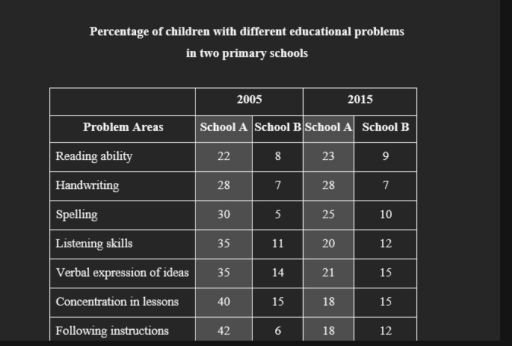
The image presents a table with data on the percentage of children with different educational problems in two primary schools across two years, 2005 and 2015. Problem areas are divided into Reading ability, Handwriting, Spelling, Listening skills, Verbal expression of ideas, Concentration in lessons, and Following instructions. School A in 2005 shows 22% in Reading ability, 28% in Handwriting, 30% in Spelling, 35% in Listening skills, 35% in Verbal expression of ideas, 40% in Concentration in lessons, and 42% in Following instructions. School B in 2005 shows 8% in Reading ability, 7% in Handwriting, 5% in Spelling, 11% in Listening skills, 14% in Verbal expression of ideas, 15% in Concentration in lessons, and 6% in Following instructions. In 2015, School A percentages are 23% in Reading ability, 28% in Handwriting, 25% in Spelling, 20% in Listening skills, 21% in Verbal expression of ideas, 18% in Concentration in lessons, and 18% in Following instructions. In 2015, School B percentages are 9% in Reading ability, 7% in Handwriting, 10% in Spelling, 12% in Listening skills, 15% in Verbal expression of ideas, 15% in Concentration in lessons, and 12% in Following instructions.
Given the complexity of the image, the above description may not be entirely accurate.
Skyrocket your IELTS band score by 1-2 points in under a month with our premium plan!
Note: Both the topic and the answer were created by one of our users.
The given table illustrates the hinderances that cramp the process of learning of children in two primary school in 2005 and 2015 separately.
Overall, students in these schools suffered from 7 key scourges that disturb their study, with the most problematic being the ability to concentrate in class and following instructions.
In 2005, hardships related to reading, or dyslexia, occurred to more than a third of students in school A, while only 8% of the students seemed to share the same disability in school B, and by 2015, the figure only grew by 1% in both schools. Following this, a third of students in school A in 2005 and a ninth of students in school B withstood issues concerning listening skills and verbal expression of ideas. However, 2015 saw a discernible amelioration in the above-mentioned skills, whereas school B students only worsened over the years. The problem with handwriting and spelling still persisted until 2015, standing at 28% and 30% in school A, followed by 7% and 10% in school B respectively. The most common problem in school A in 2005 was the ability to concentrate in lessons, and follow instructions with a staggering 40% and 42% correspondingly, but exhibited drastic changes until 2015, with only 15% and 6%. However, these two issues were much less tantalizing, taking up an equal percentage of 18%, and only witnessed marginal enhancement 10 years afterwards.
Word Count: 232
