Our system will evaluate the answer based on this AI-generated description.
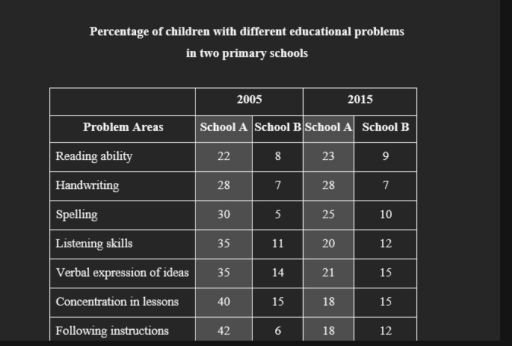
The image presents a table with data on the percentage of children with different educational problems in two primary schools across two years, 2005 and 2015. Problem areas are divided into Reading ability, Handwriting, Spelling, Listening skills, Verbal expression of ideas, Concentration in lessons, and Following instructions. School A in 2005 shows 22% in Reading ability, 28% in Handwriting, 30% in Spelling, 35% in Listening skills, 35% in Verbal expression of ideas, 40% in Concentration in lessons, and 42% in Following instructions. School B in 2005 shows 8% in Reading ability, 7% in Handwriting, 5% in Spelling, 11% in Listening skills, 14% in Verbal expression of ideas, 15% in Concentration in lessons, and 6% in Following instructions. In 2015, School A percentages are 23% in Reading ability, 28% in Handwriting, 25% in Spelling, 20% in Listening skills, 21% in Verbal expression of ideas, 18% in Concentration in lessons, and 18% in Following instructions. In 2015, School B percentages are 9% in Reading ability, 7% in Handwriting, 10% in Spelling, 12% in Listening skills, 15% in Verbal expression of ideas, 15% in Concentration in lessons, and 12% in Following instructions.
Given the complexity of the image, the above description may not be entirely accurate.
Skyrocket your IELTS band score by 1-2 points in under a month with our premium plan!
Note: Both the topic and the answer were created by one of our users.
The table provides information about various educational problems faced by children over the decade, starting from 2005.
overall, it can be seen from the table, school a was dominant at educational problems than school b over the period. academic difficulties was seen to have decreased in school a, expect from reading ability throughout period, opposite trend was true for school b.
looking from details, starting with 22%, the proportion of children facing reading ability problems in school a experienced a rise of 23 % in 2015, while the figure for handwriting remained unchanged over the decade. more children struggled from spelling in 2005 than in 2005 with 5 -percent differences (30%-25%). school a children had a same difficulties from listening and verbal expression of ideas with 35% but after 10 years, this trend was reported to have fallen in 2015, with respective figures accounting for 11% and 14%. 40% of children in school a struggled with concentration in lesson in 2005 and it was 2% lower than that of following instructions, however, these figures decreased significantly to 18 % in 2015.
as to school b students, reading ability, handwriting, listening skills, verbal expression of ideas and concentration in lessons almost remained consistansy over the period, spelling and following instructions were seen a double rise from 5 to 10 and from 6 to 12 respectively.
Word Count: 224
