Our system will evaluate the answer based on this AI-generated description.
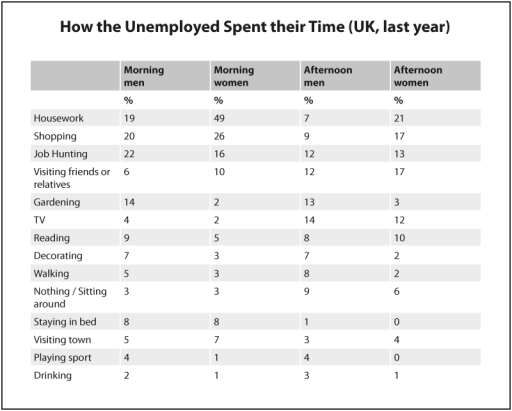
The image shows a chart of how unemployed individuals in the UK spent their time last year, divided into morning and afternoon activities for both men and women. Housework was the most common activity for women in the morning (49) and afternoon (21), while job hunting was the highest for men in the morning (22) and afternoon (12). Women also spent significant time visiting friends or relatives in the afternoon (17). Gardening was more common in the afternoon for both men (13) and women (3). Morning reading was slightly higher for men (9) than women (5), but the opposite was true in the afternoon with women at 10 and men at 8. Walking was more common in the afternoon for men (8) than women (2). Both men and women spent equal time staying in bed in the morning (8), but only men stayed in bed in the afternoon (1). Playing sports and drinking were the least common activities, with both being slightly higher in the afternoon for men (4).
Given the complexity of the image, the above description may not be entirely accurate.
Skyrocket your IELTS band score by 1-2 points in under a month with our premium plan!
Note: Both the topic and the answer were created by one of our users.
The given table delineates data pertaining how unemployed people in the UK allocated their time for manifold activities according to genders.
A striking feature is that housework was the dominant morning activity for women at 49%, compared to men at 19%. Conversely, men were more engaged in gardening, at 14% in the morning and 13% in the afternoon, a task which only 2% and 3% of women undertook, respectively.
Shopping was a common morning activity, with 20% of men and 26% of women participating, but these figures dropped in the afternoon. Job hunting occupied 22% of men and 16% of women in the mornings, slightly reducing to 12% and 13% in the afternoons.
Social visits were equally favored by women in both halves of the day (10% and 17%), whereas men’s participation dropped from 6% in the morning to 12% in the afternoon. Television watching was a more popular afternoon activity for both genders, rising from 4% to 14% for men and 2% to 12% for women. Notably, more women than men stayed in bed in the afternoon, although the percentages were low (men 1%, women 4%). Lastly, engaging in sports and drinking were the least popular activities, with men slightly more inclined towards these than women.
Word Count: 207
