Our system will evaluate the answer based on this AI-generated description.
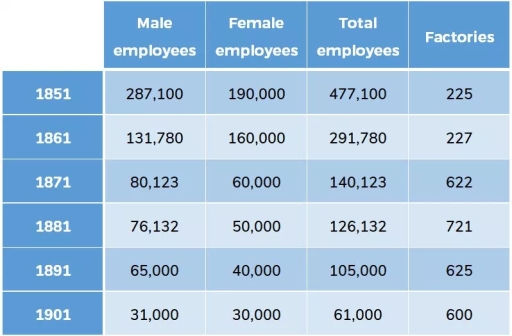
The image is a table with five rows and five columns. The first column headers are "Male employees," "Female employees," "Total employees," and "Factories." The rows are labeled with years 1851 to 1901 in increments of 10 years. In 1851, male employees were 287,100, female employees were 190,000, total employees were 477,100, and there were 225 factories. In 1861, male employees dropped to 131,780, female employees to 160,000, total employees to 291,780, and factories increased to 227. By 1871, male employees decreased to 80,123, female employees to 60,000, total to 140,123, and a significant jump in factories to 622. In 1881, male employees were 76,132, female employees at 50,000, total employees at 126,132, and factories rose to 721. By 1891, male employees fell to 65,000, female to 40,000, total to 105,000, and factories dropped to 625. Finally, in 1901, male employees were 31,000, female employees at 30,000, total employees at 61,000, and factories reduced to 600.
Given the complexity of the image, the above description may not be entirely accurate.
Skyrocket your IELTS band score by 1-2 points in under a month with our premium plan!
Note: Both the topic and the answer were created by one of our users.
The table illustrates data about workforce in silk production, in two countries, England and Wales, over a period of 50 years, starting from 1851.
Overall, it is clear that during these 50 years the number of total employees in both countries decreased substantially and female workers contributed the highest workforce. Nevertheless, factories did not follow the same trend and despite having some minor fluctuations, between 1861 and 1901, their numbers increased significantly.
In 1851, the number of total employees was at its peak, amounting to 130,750, including 53964 men and 76786 women. Even though this year accounted for the largest workforce compared to other years, the number of factories was at the bottom, at 272 to be specific. However, ten years later, the amount of factories almost tripled, reaching 761, while the total employees number experienced a dramatic fall of over 20000 people.
Over the next 40 years, the workforce was reduced significantly, reaching its bottom in 1901 at 38942 employees. In addition to this, factories witnessed small fluctuations, however they also were at their lowest in 1901, accounting for 623 factories, excluding the year of 1851.
Word Count: 187
