Our system will evaluate the answer based on this AI-generated description.
The image exhibits a line graph titled 'Obesity Rate (by age)' with years on the x-axis ranging from 1971 to 2005 and percent on the y-axis from 0 to 45. There are four labeled trend lines: 18-29, 30-44, 45-64, and 65-74. The 18-29 age group starts at approximately 5% in 1971, gradually increasing to 15% in 1988, then to 17.5% in 1999, and reaching just over 17.5% in 2005. The 30-44 age group begins around 12.5% in 1971, escalating to 25% in 1988, surging to just below 35% in 1999, and peaking around 37.5% in 2005. The 45-64 segment initiates at just below 15% in 1971, climbing to just below 30% in 1988, soaring to approximately 37.5% in 1999, and attaining nearly 40% in 2005. Lastly, the 65-74 cohort commences at roughly 12.5% in 1971, advances to just below 20% in 1988, amplifies to just over 20% in 1999, and culminates at 22.5% in 2005.
Given the complexity of the image, the above description may not be entirely accurate.
Skyrocket your IELTS band score by 1-2 points in under a month with our premium plan!
Note: Both the topic and the answer were created by one of our users.
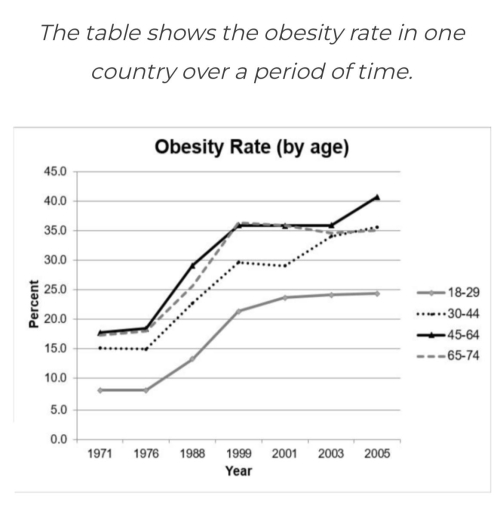
The table illustrate the obseity rate in one country from 1971 to 2005 in terms of their age groups. Units are measured in percentage.
Overall, there has been an excessive increase in the percentage of people suffering from obesity over the past years. The highest number of obesity is found among 45-64 age group and the least among young adults (18 to 29 years old).
In 1971, all people had less than 20% of obesity rate, whilst 18 to 29 years old at least (less than 10%) and 45 to 74 aged just more than 16%. Though, with years passing, there had been a peak rise on obesity rate.
However, by 2005 most age group had obsety rate more than 35% among their peer groups, other than young adults, nonetheless, they had a rise too from around 8% in 1971 to around 20% by 2005 respectively.
Middle aged people (30 to 44 years old) and aged class of the society (65 to 74 years old) had almost the same rate of obesty by 2005 (slightly more than 35%). However, the peak rise in the obesty among 45 to 64 years are concerning (more than 40% by 2005), this may be the result of high dependence on fast food and less excrises among that age group due to lack of work life balance.
Word Count: 222
