Our system will evaluate the answer based on this AI-generated description.
The image is a bar graph representing the number of days lost due to on-the-job injuries per worker across five countries over three-time periods. In Germany, 1991-1995 shows 2.5 days, 1996-2000 shows 5 days, and 2001-2005 shows 3.75 days. In America, 1991-1995 shows 5 days, 1996-2000 shows 7.5 days, and 2001-2005 shows 5.75 days. In China, 1991-1995 shows 7.5 days, 1996-2000 shows 10 days, and 2001-2005 shows 6.25 days. In Korea, 1991-1995 shows 10 days, 1996-2000 shows 2.5 days, and 2001-2005 shows 5 days. In Brazil, 1991-1995 shows 5 days, 1996-2000 shows 3.75 days, and 2001-2005 shows 2.5 days. The x-axis lists the countries Germany, America, China, Korea, and Brazil, and the y-axis measures the number of days from 0 to 10 in increments of 2.5. There are three sets of bars for each country, each representing a different time period with the key indicating light blue for 1991-1995, dark blue for 1996-2000, and medium blue for 2001-2005.
Given the complexity of the image, the above description may not be entirely accurate.
Skyrocket your IELTS band score by 1-2 points in under a month with our premium plan!
Note: Both the topic and the answer were created by one of our users.
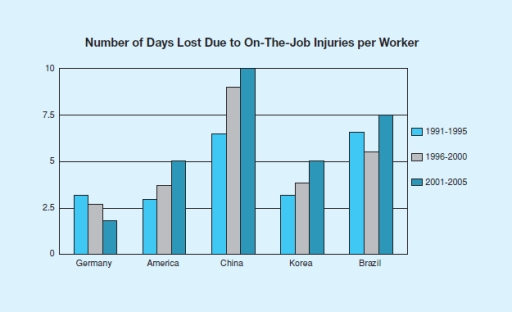
The chart illustrates the number of day-offs due to injury per worker in Germany, America, China, Korea, and Brazil. The data is divided to three periods of time, from 1991 to 1995, continued with 1996 to 2000, and followed by 2001 to 2005.
Overall, China had the highest number of days lost, while Germany had the lowest. The number for Germany also decreased over the time period, while the numbers in America, China, and Korea increased instead. On another side, in Brazil, the number plummeted in the second time period before it went up again in the third time period.
Germany started with above 2.5 days lost in 1991 to 1995, but the number continued to fall until it reached below 2.5 in 2001 to 2005. In contrast, both America and Korea started at the number of above 2.5 days in 1991 to 1995 and climbed to approximately 5 days in 2001 to 2005. Meanwhile, China began with the number of between 5 and 7.5 days in 1991 to 1995 and skyrocketed to 10 days in 2001 to 2005.
There were between 5 and 7.5 days off due to job injuries in Brazil during 1991 to 1995. Then, the number went down to almost 5 days in 1996 to 2000. However, the number jumped again to 7.5 days in 2001 to 2005.
Word Count: 222
