Our system will evaluate the answer based on this AI-generated description.
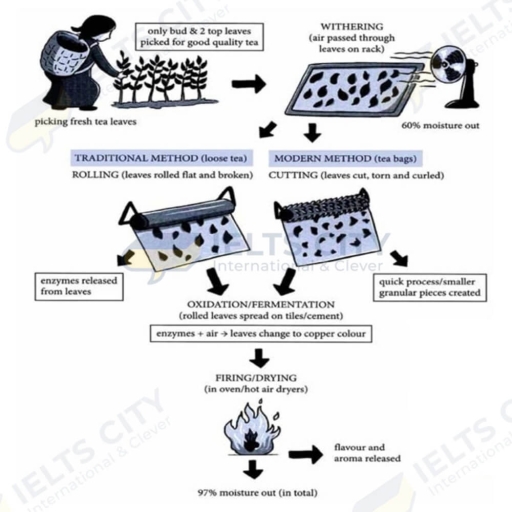
The image illustrates a tea production process starting with picking fresh tea leaves, where only the bud and 2 top leaves are selected for good quality tea. The next step is withering, where air is passed through leaves on a rack, removing 60% of moisture. The process then diverges into two methods: a Traditional Method for loose tea, which involves rolling leaves flat and broken to release enzymes, and a Modern Method for tea bags, which involves cutting leaves (cut, torn, and curled) in a quick process to create smaller granular pieces. Both methods proceed to oxidation/fermentation, where rolled leaves are spread on tiles or cement, and the interaction of enzymes and air changes the leaves to a copper colour. The final stage is firing/drying in an oven or hot air dryer, which releases flavour and aroma, resulting in a total of 97% moisture being removed.
Given the complexity of the image, the above description may not be entirely accurate.
Skyrocket your IELTS band score by 1-2 points in under a month with our premium plan!
Note: Both the topic and the answer were created by one of our users.
The diagram illustrates two different processes for manufacturing black tea.
Overall, two processes comprise a number of various steps, beginning with collecting fresh tea leaves and ending with the drying stage. The only difference between traditional and modern method is in the processing stage.
At the beginning of the process, only bud and top two leaves are collected from tea plants for high quality tea. Thereafter, the leaves undergo a withering step where air is passed through the leaves on racks, removing 60% of moisture.
In the traditional method, the leaves are rolled to become flat and broken, releasing enzymes from the leaves. Meanwhile, in the modern method, the leaves are cut, torn and curled, which results in smaller granular pieces. Oxidation or fermentation stage is the next step where both types of the leaves are spread on tiles or cement. During this step, the enzymes react with air, changing the leaves into copper colour. Finally, the leaves are fired and dried in ovens or hot air dryers, removing 97% moisture and releasing flavor and aroma.
Word Count: 176
