🔥 Today Only: Save 30% on Premium — Offer Ends Soon! - Upgrade Now!
Bar Chart

Band 6+: This graph shows the world meat production from 1950 to 1990. Describe the graph by your own words.

Image for topic: This graph shows the world meat production from 1950 to 1990. Describe the graph by your own words.
Our system will evaluate the answer based on this AI-generated description.
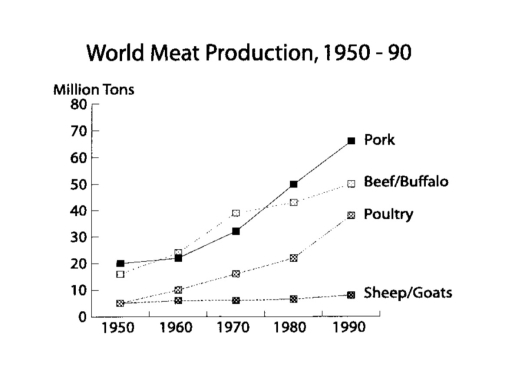
The image depicts a graph titled "World Meat Production, 1950 - 90" with the y-axis labeled "Million Tons" from 0 to 80, and the x-axis marked with the years 1950, 1960, 1970, 1980, and 1990. Four types of meat are plotted: Pork, Beef/Buffalo, Poultry, and Sheep/Goats. Pork production shows a steady increase from approximately 20 million tons in 1950 to around 70 million tons in 1990. Beef/Buffalo production starts at roughly 10 million tons in 1950 and escalates to near 50 million tons in 1990. Poultry production begins below 10 million tons in 1950, with a sharp climb to just over 30 million tons in 1990. Sheep/Goats production commences at about 5 million tons in 1950 and rises slightly above 10 million tons in 1990. Each data point is connected with lines, with Pork and Beef/Buffalo using solid lines and Poultry and Sheep/Goats using dashed lines.
Given the complexity of the image, the above description may not be entirely accurate.
Note: Both the topic and the answer were created by one of our users.

The given line graph highlights the data about the global production of meat in four decades starting from 1950 to 1990.

Overall the proportion of pork beef and poultry showed a moderate upward trend between 1950 and 1990 , whereas the sheep production maintained the same level over the period.

At the beginning of the period in 1950 the figure for pork was the highest among four types of meat with 20 million tons. 1960 saw a minimal rise to about 22 million tons in the amount of pork producing . In the following three decades the quantity of manufacturing of pork tripled to around 66 million tons. Meanwhile there was a gap of 10 million tons between the percentage of Buffalo and poultry producing at about 15 and 5 million tons respectively in 1950. These lines showed gradual but significant increase to approximately 50 and 40 million tons from 1960 to 1990.

Turning to details the production of goats was as high as the proportion of poultry at around 5 million tons in 1950. In struck contrast the share of sheep remained unchanged throughout 40 years.

Word Count: 187

Answers On The Same Topic:

This graph shows the world meat production from 1950 to 1990. Describe the graph by your own words.

The line graph depicts how many millions of tons of different types of meat were produced across the world from 1950 to 1990. Production of all kinds of meats, pork, beef/buffalo and poultry to name a few grew from their original amount by the end of the given time. No form of meat saw any […]

This graph shows the world meat production from 1950 to 1990. Describe the graph by your own words.

The given line graph highlights the data about the global production of meat in four decades ,starting from 1950 to 1990. Overall, the proportion of pork beef and poultry showed a moderate upward trend between 1950 and 1990 , whereas the sheep production maintained the same level over the period. At the beginning of the […]

This graph shows the world meat production from 1950 to 1990. Describe the graph by your own words.

The chart illustrates world meat production, in between 1950 and 1990, and comparing production amount of pork, beef/buffalo meat, poultry and sheep/goat meat in million tons by year. In 1950, production of sheep/goat meat was exactly the same with the poultry, around five million tons. Beef was following pork which was produced precisely 20 million […]

This graph shows the world meat production from 1950 to 1990. Describe the graph by your own words.

The line graph illustrates 4 different types of meat types in world production between 1950 and 1990. Overall, pork took the lead by rocketing and beef/buffalo and poultry increasedgradually over the period. However, sheep/goats keep unchanged in the least number. As regards pork and beef/buffalo began in similar number around 20 million tonnes in 1950. […]

See All

Other Topics:

You should spend about 20 minutes on this task. The bar chart below shows the global TV audience reach of selected sporting events. Write a report for a university lecturer describing the data and make comparisons where relevant. Write at least 150 words.

The presented bar chart provides information about the global TV audience reach of several sport events.Global audience reach is the amount of people who saw at least a minute of each on TV. The amounts are calculated in billions. Overall, Olympics was the sport event with the biggest global popularity, reaching the highest or near […]

The graph shows the share of unemployed people aged between 15 and 24 in five European countries in 2005. Summarise the information by selecting and reporting the main features, and make comparisons where relevant.

The bar chart compares the proportion of unemployed individuals aged between 15 and 24 in five different European countries, as well as their overall unemployment rates (Poland, Italy, Hungary, Germany, and Denmark). Overall, unemployed young adults recorded higher figures than overall unemployment, while the opposite pattern could be observed in the latter category. Turning to […]

The bar graph below shows the area of forest logged in Southwest region and the table presents the number of forest-dwelling species in the same region

The bar graph and the table show the forest area of Southwest region that have been cut down in different period of time and the number of species that live in in Southwest forest. Overall, the area of the forest that have been logged has been increased overtime since 1990 and the amount of the […]

The bar chart below shows the average amount of money spent per month by households in a particular city on five different categories in 2010 and 2020. Summarise the information by selecting and reporting the main features and make comparisons where relevant.

The given bar chart illustrates five different categories that households spent money on per month in a particular city between 2010 and 2020. Overall, the maximum and the minimum amounts of money were spent on housing and clothing in both 2010 and 2020, respectively. The average figure for food and entertainment slightly increased by approximately […]

The chart below shows the expenditure on three categories among different age groups of residents in the UK in 2004

The bar chart compares the percentages of total spending from different age groups of citizens in three categories in the UK in 2004. Overall, food and drink expenditure generally increased with age, while spending on restaurant and hotel declined. Entertainment spending peaked among those aged 61-75. In terms of people aged under 61, the youngest […]

The chart below shows the aid from six developed countries to developing countriesfrom 2008-2010. Summarize the information by selecting and reporting the mainfeatures, and make comparisons where relevant.

The bar chart illustrates the amounts of foreign aid given by six developed nations to developing countries over a three-year period from 2008 to 2010. Overall, the USA was by far the largest donor throughout the period, while the other five countries gave considerably smaller and broadly comparable amounts. Most countries saw their aid contributions […]

See All
We have detected unusual activity on your device.
Please verify your identity to continue.
Note: This verification step won't sign you in. If you have a premium account, please log in to access the service as usual.
Google/Gmail Verification
Or verify using Email/Code
We've sent a verification code to:
youremail@gmail.com (Not your email?)
Enter it below to complete the verification process.
Ensure your email address is correct, your inbox is not full, and you check your spam folder. If no email arrives, consider using an alternative email.
You will need a Premium plan to perform your action!
Note: If you already have a premium account, please log in to access our services as usual.

Plans & Pricing

Our mission is to make quality education accessible for everyone.
However, to keep our hardworking team running and this service alive, we genuinely need your support!
By opting for a premium plan, not only do you sustain us in achieving the mission, but you also unlock advanced features to enrich your learning experience.

Free

For learners who aren't pressed for time

What's included on Free
100+ Cambridge IELTS Tests
Instant IELTS Writing Task 1 & 2 Evaluation (2 times/month)
Instant IELTS Speaking Part 1, 2, & 3 Evaluation (2 times/month)
Instant IELTS Writing Task 1 & 2 Essay Generator (2 times/month)
500+ Dictation & Shadowing Exercises
100+ Pronunciation Exercises
Flashcards
Other Advanced Tools

Premium

For those serious about advancing their English proficiency, and for IELTS candidates aspiring to boost their band score by 1-2 points (especially in writing & speaking) in just 30 days or less

What's included on Premium
Save Your IELTS Test Progress & Analyze Mistakes By Question Type
Save Your Own Flashcard Sets & Use Them On Any Device
Unlock All Courses, IELTS Tests, Section & Part Practice
Unlimited AI Conversations
Unlimited AI Writing Enhancement Exercises
Unlimited IELTS Writing Task 1 & 2 Evaluation
Unlimited IELTS Speaking Part 1, 2, & 3 Evaluation
Checked Answers Will Not Be Published
Unlimited IELTS Writing Task 1 & 2 Essay Generator
Unlimited IELTS Speaking Part 1, 2, & 3 Sample Generator
Unlimited Usage Of Advanced Tools & AI Features
Priority Support within 24h (12-month plan only)

Due to the nature of our service and the provided free trials, payments are non-refundable.