Our system will evaluate the answer based on this AI-generated description.
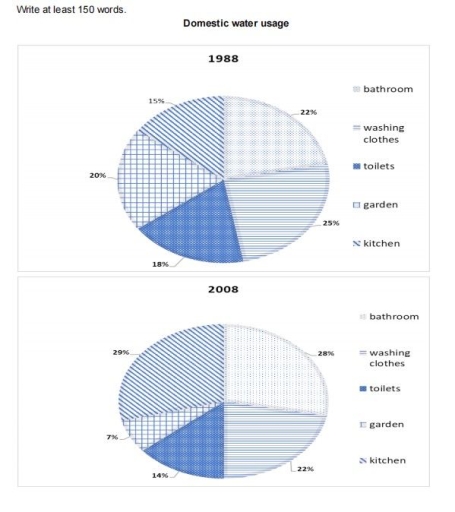
The image contains two pie charts depicting domestic water usage in the years 1988 and 2008. In the 1988 chart, percentages allocated to categories are as follows: bathroom (22%), washing clothes (15%), toilets (25%), garden (20%), and kitchen (18%). In the 2008 chart, the percentages for each category are displayed as: bathroom (28%), washing clothes (14%), toilets (29%), garden (7%), and kitchen (22%). The 2008 chart showcases a significant increase in water usage for bathrooms and toilets compared to the 1988 chart, with a 6% and 4% rise respectively. Conversely, the usage for washing clothes and garden are noticeably decreased by 1% and 13% respectively in the 2008 chart. Kitchen usage stays relatively similar across both years, only showing a slight increase of 4% in the 2008 chart. The charts are titled "Domestic water usage" and labeled with the specific years they represent.
Given the complexity of the image, the above description may not be entirely accurate.
Skyrocket your IELTS band score by 1-2 points in under a month with our premium plan!
Note: Both the topic and the answer were created by one of our users.
The pie chart illustrates the amount of spending water in five section and in one country from 1988 to 2008.
Overall,it is evident that the most used figure were bathroom and washing clothes, while the users of water in the kitchen increased significantly.In contrast the amount of water for garden reduced dramatically and toilets remained stable.
In 1988, only 22 percent of water had used for bathroom and the water for kitchen had spent 15%.After 20 years , both figure went up to 28% and 29% , respectively.
Besides that , one of the most spent water was in garden with 20 per cent in 1988. However, it has decreased marginally to 7%.Moreover, for toilets and washing machine water percentage numbered 25% and 18% but in 2008 it has shown decline to 22% and 14% .
Word Count: 136
