Our system will evaluate the answer based on this AI-generated description.
The image includes two graphs: one showing world population growth, reaching 1 billion in 1850, 2 billion by 1950, approximately 3.8 billion by 2000, peaking at around 8 billion by 2050, then declining to about 7 billion by 2100. The second graph portrays world urban population with developed regions at about 1 billion in 2005 and developing regions at about 1.4 billion, while in 2010 developed regions reach 1.1 billion and developing regions about 1.8 billion; in 2015, developed regions are approximately 1.2 billion and developing regions around 2.2 billion; in 2020, developed regions are about 1.2 billion and developing regions approximately 2.6 billion; by 2025, developed regions reach roughly 1.3 billion and developing regions about 3 billion; in 2030, developed regions are around 1.3 billion and developing regions close to 3.3 billion.
Given the complexity of the image, the above description may not be entirely accurate.
Skyrocket your IELTS band score by 1-2 points in under a month with our premium plan!
Note: Both the topic and the answer were created by one of our users.
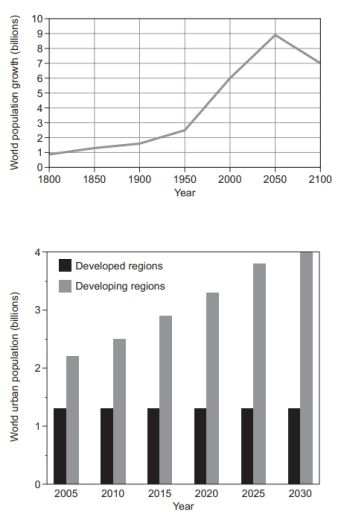
The line graph shows the data on global population growth for three centuries, from 1800 to 2100. Different regions are presented in the bar graph for the urban population.
Overall, world population growth has an increasing value over time for both regions. Developing regions increased in billions while developed regions, on the other hand, remain constant over the years.
It can be seen from the line graph that from 1800 to 1950 the world population growth gradually increases starting from approximately 1 billion to 2.5 billion people. Then from 1950 to 2050 the population was predicted to rose suddenly from 2.5 billions to 9 billion for a matter of 1 century.
Regarding the comparison of developed and developing regions, noticeably, between 2005 and 2030 it can be seen that developed regions remained unchanged whereas in the developing regions the urban population go up for almost 2 billions in a span of 25 years of time.
Word Count: 155
