24 Hours Only: Get 39% OFF on Our Premium Plan - Check Out Now!
Table

Band 5+: You should spend about 20 minutes on this Task. The charts show (Chart a) the average speed of urban zone traffic (in kilometres per hour or kph) in a number of countries over a fifty year period, including a future estimate; and also (Chart b) the total number of urban zones per country (in thousands.) Write a report summarising the information. Select and describe the main features, and make comparisons where relevant.

Image for topic: You should spend about 20 minutes on this Task. The charts show (Chart a) the average speed of urban zone traffic (in kilometres per hour or kph) in a number of countries over a fifty year period, including a future estimate; and also (Chart b) the total number of urban zones per country (in thousands.) Write a report summarising the information. Select and describe the main features, and make comparisons where relevant.
Our system will evaluate the answer based on this AI-generated description.
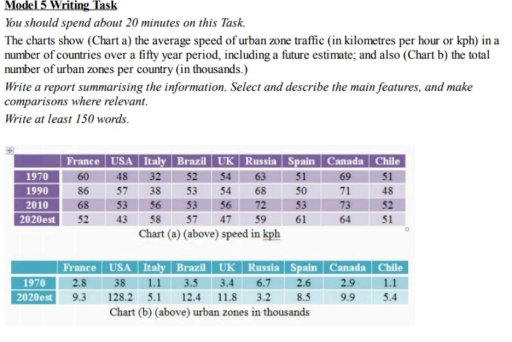
The image contains two charts: Chart (a) displays urban traffic speed (in kph) for France: 48 (1970), 55 (1990), 52 (2010), 72 (2020est); USA: 32 (1970), 48 (1990), 43 (2010 and 2020est); Italy: 52 (1970), 52 (1990), 54 (2010), 65 (2020est); Brazil: 54 (1970), 54 (1990), 56 (2010), 67 (2020est); UK: 53 (1970), 53 (1990), 62 (2010), 79 (2020est); Russia: 61 (1970), 63 (1990), 61 (2010), 64 (2020est); Spain: 69 (1970), 51 (1990), 65 (2010), 70 (2020est); Canada: 51 (1970), 59 (1990), 63 (2010), 71 (2020est); Chile: 51 (1970), 52 (1990), 53 (2010), 52 (2020est); Chart (b) shows urban zones (in thousands) for France: 2.8 (1970), 9.3 (2020est); USA: 38 (1970), 128.2 (2020est); Italy: 1.1 (1970), 15.1 (2020est); Brazil: 3.4 (1970), 12.4 (2020est); UK: 6.4 (1970), 11.8 (2020est); Russia: 6.7 (1970), 3.2 (2020est); Spain: 2.6 (1970), 8.5 (2020est); Canada: 9.9 (1970), 9.9 (2020est); Chile: 1.1 (1970), 5.4 (2020est).
Given the complexity of the image, the above description may not be entirely accurate.
Note: Both the topic and the answer were created by one of our users.

The charts give changes in the mean city traffic zone speed and the total number of city areas between 1970 and 2010, also including a forecast for 2020.

Overall, there is no any correlation between the speed of urban zones and its total number.

Countries, such as France, USA, UK, Russia, Canada exhibited initial increase, followed by an immediate decrease: France and USA started at 60 kph and 48kph, respectively, in 1970, increasing to peak 86kph and 57 kph, respectively, in1990, ultimately declining to estimate 52 and 43, respectively, in 2020. Likewise, UK, Russia and Canada also followed identical pattern. UK started at 54, increasing by 2 kph to reach the peak in 2010, decreasing to estimate 47 in 2020. Russia started at 63 kph, rising to 72 in 2010,followed by a drop at estimate 59 in 2020. Canada started at 63, reached its peak in 2010 at 73, before falling to estimate 64 in 2020.

On the other hand, an upward trend was observed in countries such as Italy,Brazil, Spain, with respective numbers at 32 kph, 52kph,51 kph, initially. Ulwimately they reached 58kph,57kph,61kph, respectively. By contrast, Chile remained relatively stable over the given period.

Regarding urban zones, a rising trend was observed for all of countries.

Word Count: 207

Answers On The Same Topic:

You should spend about 20 minutes on this Task. The charts show (Chart a) the average speed of urban zone traffic (in kilometres per hour or kph) in a number of countries over a fifty year period, including a future estimate; and also (Chart b) the total number of urban zones per country (in thousands.) Write a report summarising the information. Select and describe the main features, and make comparisons where relevant.

The tables illustrate the average speed of vehicles in an urban city and a total amount of urban areas per country across 9 different countries between 1970 and future prediction. Overall, chart A demonstrates that all 9 countries experienced fluctuations in the value of average speed. While it illustrates that some countries witnessed a decrease […]

You should spend about 20 minutes on this Task. The charts show (Chart a) the average speed of urban zone traffic (in kilometres per hour or kph) in a number of countries over a fifty year period, including a future estimate; and also (Chart b) the total number of urban zones per country (in thousands.) Write a report summarising the information. Select and describe the main features, and make comparisons where relevant.

The table demonstrates information about the average speed in urban areas and also a prediction for the coming year in a variety of countries over 50 years; the amount of urbanized districts each country has. Overall, in chart a, some countries rose and others illustrated a decline in kph. In the second table, there was […]

You should spend about 20 minutes on this Task. The charts show (Chart a) the average speed of urban zone traffic (in kilometres per hour or kph) in a number of countries over a fifty year period, including a future estimate; and also (Chart b) the total number of urban zones per country (in thousands.) Write a report summarising the information. Select and describe the main features, and make comparisons where relevant.

The first table illustrates the average speed in urban zones in 9 countries from 1970 to 2020 in kilometres per hour. The second table demostrates the size of urban zones in thousands in the same countries. Overall, in almost all countries the average speed is decreasing slightly for 50 years. Also the count of urban […]

See All

Other Topics:

The table below shows information about spending on health in five different countries in 2002. Summarise the information by selecting and reporting the main features and make comparisons where relevant. Write at least 150 words.

The table illustrates the percentage of spending on health in five different countries, namely Japan, Italy, France, Germany, and the USA in 2002. Overall, while the proportion of health in USA fluctuated significantly over the period, all other regions experienced a consistent decline in spending. In total spending, USA accounted for the largest share, at […]

The table below gives information on consumer spending on different items in five different countries in 2012.

The graph shows that the each five countries’s percentage of national consumer expenditure by each three category in 2002. Firstly, People conseming the food and drink category is the highest percantage of all of five countries. In addition Turkey had the biggest percantage routhly one-third. Composing between Turkey and Sweden, there are about two-times. Also, […]

The table shows advertisement expenditure by four car companies in 2002 (in total and how the money was spent). Summarize the information by selecting and reporting the main features and make comparisons where relevant.

The table illustrates how the total amount of money, spent on four kinds of traditional media, was allocated by four car companies in 2002. What is most striking when looking at the data is that the two automobile manufacturers with the highest marketing expenditure are Renault (UK) and Porsche. It is also important to note […]

The diagram below shows the changes in the number of people who rely on fuel from organic sources from 2004 to 2030. Summarise the information by selecting and reporting the main features, and make comparisons where relevant.

The diagram illustrates the fluctuations in the number of individuals dependent on fuel derived from organic sources across various regions from 2004 to 2030. Overall, it is evident that while certain regions exhibit significant growth in reliance on organic fuels, particularly Sub-Saharan Africa and India, others such as China and North Africa demonstrate stagnation or […]

The diagram below shows the changes in the number of people who rely on fuel from organic sources from 2004 to 2030. Summarise the information by selecting and reporting the main features, and make comparisons where relevant.

The diagram shows information about people relying on fuel from organic resources from 2004 to 2030 in different parts of the world.First of all, we can see that socio-economically lower regions like Africa are relying on organic sources for fuel more and more. In Sub-Saharan Africa reliance for organic source fuels increases around 10% every […]

The charts below show: 1. The percentage of people using three different types of transportation (car, bus, bicycle) in one European city in 1990, 2010 and 2030 (projected). 2. The average daily commuting time (in minutes) in the same years. Write at least 150 words.

The two tables give information about the proportion of individuals and their average commuting time (in minutes) by using three forms of transportation (car, bus, bicycle) in 1990, 2010 and prediction for 2030. Overall, the car represented the highest figures and in the future, it may become dominant and this was followed by bus. Notably, […]

See All
We have detected unusual activity on your device.
Please verify your identity to continue.
Note: This verification step won't sign you in. If you have a premium account, please log in to access the service as usual.
Google/Gmail Verification
Or verify using Email/Code
We've sent a verification code to:
youremail@gmail.com (Not your email?)
Enter it below to complete the verification process.
Ensure your email address is correct, your inbox is not full, and you check your spam folder. If no email arrives, consider using an alternative email.
You will need a Premium plan to perform your action!
Note: If you already have a premium account, please log in to access our services as usual.

Plans & Pricing

Our mission is to make quality education accessible and free for everyone.
However, to keep our hardworking team running and this service alive, we genuinely need your support!
By opting for a premium plan, not only do you sustain us in achieving the mission, but you also unlock advanced features to enrich your learning experience.

Free

For learners who aren't pressed for time

What's included on Free
1000+ IELTS Tests & Samples
Instant IELTS Writing Task 1 & 2 Evaluation (2 times/month)
Instant IELTS Speaking Part 1, 2, & 3 Evaluation (5 times/month)
Instant IELTS Writing Task 1 & 2 Essay Generator (2 times/month)
500+ Dictation & Shadowing Exercises
100+ Pronunciation Exercises
Flashcards
Other Advanced Tools

Premium

For those serious about advancing their English proficiency, and for IELTS candidates aspiring to boost their band score by 1-2 points (especially in writing & speaking) in just 30 days or less

What's included on Premium
Save Your IELTS Test Progress
Unlock All Courses & Content
Unlimited AI Conversations
Unlimited AI Writing Enhancement Exercises
Unlimited IELTS Writing Task 1 & 2 Evaluation
Unlimited IELTS Speaking Part 1, 2, & 3 Evaluation
Checked Answers Will Not Be Published
Unlimited IELTS Writing Task 1 & 2 Essay Generator
Unlimited IELTS Speaking Part 1, 2, & 3 Sample Generator
Unlimited Usage Of Advanced Tools

Due to the nature of our service and the provided free trials, payments are non-refundable.
Nếu bạn là người Việt Nam và không có hoặc không muốn trả bằng credit/debit cards, bạn có thể thanh toán bằng phương thức chuyển khoản:


Chọn gói:
279,000₫ 157,000 ₫ cho gói 1 tháng (chỉ 5,233₫/ngày)
819,000₫ 397,000 ₫ cho gói 3 tháng (chỉ 4,411₫/ngày)
1,649,000₫ 667,000 ₫ cho gói 6 tháng (chỉ 3,706₫/ngày)
3,299,000₫ 857,000 ₫ cho gói 12 tháng (chỉ 2,381₫/ngày)


Sau khi chuyển khoản, vui lòng đợi trình duyệt tự động điều hướng bạn trở lại Engnovate và bạn sẽ ngay lập tức nhận được mã kích hoạt tài khoản premium.
Nếu có lỗi xảy ra, bạn có thể liên hệ với team thông qua một trong các phương thức: email đến helloengnovate@gmail.com hoặc nhắn tin qua facebook.com/engnovate.
Vì toàn bộ công cụ trên website đều có thể sử dụng thử miễn phí, Engnovate không hỗ trợ hoàn tiền.