Our system will evaluate the answer based on this AI-generated description.
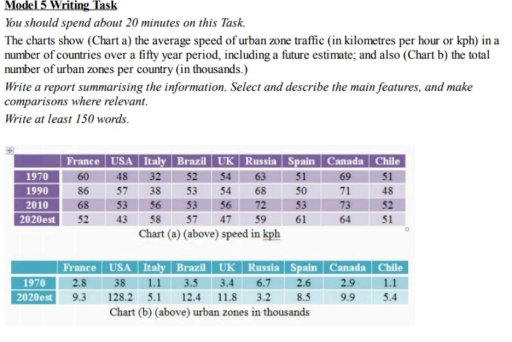
The image contains two charts: Chart (a) displays urban traffic speed (in kph) for France: 48 (1970), 55 (1990), 52 (2010), 72 (2020est); USA: 32 (1970), 48 (1990), 43 (2010 and 2020est); Italy: 52 (1970), 52 (1990), 54 (2010), 65 (2020est); Brazil: 54 (1970), 54 (1990), 56 (2010), 67 (2020est); UK: 53 (1970), 53 (1990), 62 (2010), 79 (2020est); Russia: 61 (1970), 63 (1990), 61 (2010), 64 (2020est); Spain: 69 (1970), 51 (1990), 65 (2010), 70 (2020est); Canada: 51 (1970), 59 (1990), 63 (2010), 71 (2020est); Chile: 51 (1970), 52 (1990), 53 (2010), 52 (2020est); Chart (b) shows urban zones (in thousands) for France: 2.8 (1970), 9.3 (2020est); USA: 38 (1970), 128.2 (2020est); Italy: 1.1 (1970), 15.1 (2020est); Brazil: 3.4 (1970), 12.4 (2020est); UK: 6.4 (1970), 11.8 (2020est); Russia: 6.7 (1970), 3.2 (2020est); Spain: 2.6 (1970), 8.5 (2020est); Canada: 9.9 (1970), 9.9 (2020est); Chile: 1.1 (1970), 5.4 (2020est).
Given the complexity of the image, the above description may not be entirely accurate.
Skyrocket your IELTS band score by 1-2 points in under a month with our premium plan!
Note: Both the topic and the answer were created by one of our users.
The table demonstrates information about the average speed in urban areas and also a prediction for the coming year in a variety of countries over 50 years; the amount of urbanized districts each country has.
Overall, in chart a, some countries rose and others illustrated a decline in kph. In the second table, there was an exception: Russia, with only a decreasing pattern.
France appeared to fluctuate all over the given period. In 1970, its average speed was 60, and after that, it might reach 52 kph in the estimated year unsteadily. It rose until 86 in 1990 and declined rapidly, leaving that point as the spike. Furthermore, this happens in other 5 republics as well( USA,well (USA, UK, Russia, Canada, Chile). The second trend that was in the table was a rising trend. Italy and Spain were among them, and their increases were from 32 and 51 to 58 and 61 respectively.
In the second chart, France had 2.8 thousand urban areas and it appears to be 9.3 thousand in 2020. This occurred in every country. The sum of these places will only rise regarding the prediction. However, there might be an exception. According to an estimated year, Russia will have half of its amount, from 6.7 to 3.2.
Word Count: 210
