Our system will evaluate the answer based on this AI-generated description.
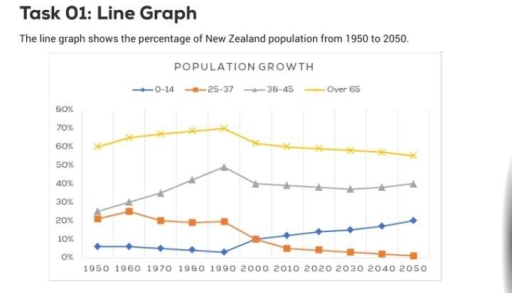
The image presents a line graph indicating population growth by age groups in New Zealand from 1950 to 2050; the age groups are 0-14, 25-37, 36-45, and over 65. In 1950, percentages for age groups were as follows: 0-14 at 45%, 25-37 at 25%, 36-45 at 20%, and over 65 at 10%. In 1960, 0-14 rose to 50%, 25-37 dropped to 20%, 36-45 remained at 20%, and over 65 increased to 15%. By 1970, all groups except 36-45 increased by 5% each, but by 1980, 0-14 declined to 40%, 25-37 grew to 30%, 36-45 stayed at 25%, and over 65 reached 20%. By 1990, 0-14 dropped to 35%, 25-37 slightly grew to 35%, 36-45 maintained at 20%, and over 65 rose to 25%. In 2000, 0-14 went down to 30%, 25-37 shrunk to 30%, 36-45 increased to 30%, and over 65 remained at 25%. In 2010, 0-14 further decreased to 25%, 25-37 went up to 40%, 36-45 slightly rose to 35%, and over 65 fell to 20%. The forecast for 2020 anticipates 0-14 at 20%, 25-37 at 45%, 36-45 at 40%, and over 65 at 30%. By 2030, 0-14 is expected to continue at 20%, 25-37 at 55%, and 36-45 at 40%, with over 65 projected to hit 35%. In 2040, predictions suggest 0-14 remaining at 20%, 25-37 peaking at 60%, 36-45 staying at 40%, and over 65 climbing to 45%. Lastly, the 2050 outlook projects 0-14 at 20%, 25-37 reducing to 55%, 36-45 maintaining at 35%, and over 65 surging to 50%.
Given the complexity of the image, the above description may not be entirely accurate.
Skyrocket your IELTS band score by 1-2 points in under a month with our premium plan!
Note: Both the topic and the answer were created by one of our users.
The two maps illustrate how the museum has changed since 1998.
Overall, it is evident that the museum has transformed dramatically, with the introduction of new facilities and the relocation of rooms.
In 1998, visitors could enter the museum from the entrance in the south. On the left of the museum stood a permanent exhibition room and a temporary exhibition room, while 2 permanent exhibition rooms, a shop, a WC and bags and coats room were situated on the other side. In the middle of the museum contained a garden and there was a cafe in the north of the building.
In 2008, there were no changes that happened to the entrance in the south. Meanwhile, a new restaurant was erected on the left side of the building, while a permanent exhibition room was replaced by a temporary exhibition room, bags and coats room and the shop. The opposite side experienced the same transformation, with 3 permanent exhibition rooms placed on the same side. There was a fountain constructed in the garden area, together with a cafe sitting area in the top left corner. The cafe in the north was shrunk to make room for the WC.
Word Count: 197
