Our system will evaluate the answer based on this AI-generated description.
The image depicts a bar chart showing the number of employed persons by job type and sex for Australia last year. The chart has seven categories: Managers, Professionals, Semi-professionals, Tradespeople, Production, Clerical, Labourers. For Managers, there are approximately 700 male and 300 female employed persons. For Professionals, there are about 600 male and 400 female employed persons. For Semi-professionals, there are around 500 male and 500 female employed persons. For Tradespeople, there are approximately 600 male and 200 female employed persons. For Production, there are about 600 male and 400 female employed persons. For Clerical, there are around 200 male and 800 female employed persons. For Labourers, there are approximately 800 male and 200 female employed persons. The chart is measured in 1000s on the x-axis, with a range from 0 to 1000.
Given the complexity of the image, the above description may not be entirely accurate.
Skyrocket your IELTS band score by 1-2 points in under a month with our premium plan!
Note: Both the topic and the answer were created by one of our users.
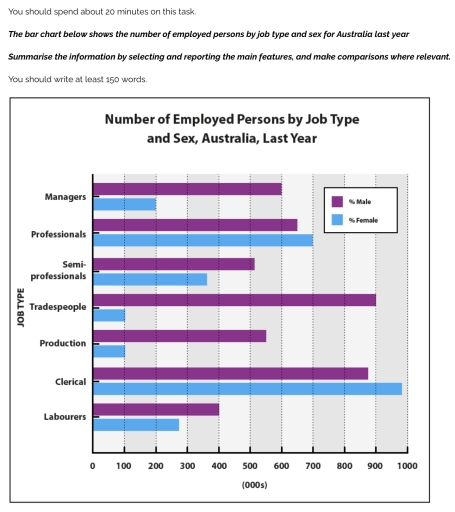
The bar chart illustrates the number of employed persons in different jobs in Australia in the previous year. Overall, it is clear that the ratio of female clerical employees was the most dominant throughout the timeframe, while male employment was the least significant in trades and production.
In terms of managers, the female employment rate accounted for 600,000 and male employment was just 200,000 in Australia, which is far greater than male employment. Afterwards, the female professionals percentage started at 700,000, but male employment was about 650,000, after that in semi-professional occupations male employment was just 500,000 and female employment was around 380,000.
On the other hand, the male employment rate in trades commenced at just 900,000, however female employment was just 100,000. Following that, the biggest amount of people worked in the clerical department, and the ratio was around 1,000,000. In contrast, the male percentage was approximately 900,000, then, the figure for male laborers was 400,000 and female laborers was about 250,000 respectively.
Word Count: 164
