Our system will evaluate the answer based on this AI-generated description.
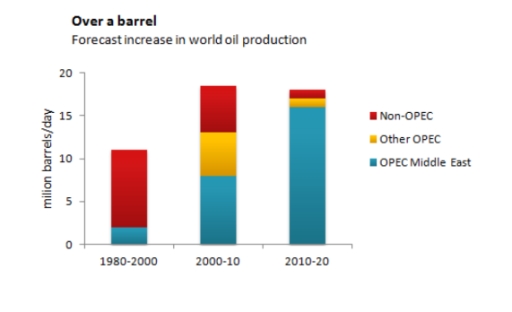
The image shows a bar graph titled 'Over a barrel' with forecasted increases in world oil production for three time periods: 1980-2000, 2000-10, and 2010-20. Three categories of oil-producing regions are represented in each bar: Non-OPEC, Other OPEC, and OPEC Middle East. The y-axis measures million barrels/day in increments of 5, from 0 to 20. From 1980-2000, Non-OPEC production increased by approximately 6 million barrels/day, Other OPEC by roughly 2 million barrels/day, and OPEC Middle East by about 3 million barrels/day. In 2000-10, Non-OPEC production saw an increase close to 4 million barrels/day, Other OPEC approximately 2 million barrels/day, and OPEC Middle East around 8 million barrels/day. For 2010-20, Non-OPEC is predicted to increase by nearly 4 million barrels/day, Other OPEC by approximately 1 million barrels/day, and OPEC Middle East by close to 7 million barrels/day.
Given the complexity of the image, the above description may not be entirely accurate.
Skyrocket your IELTS band score by 1-2 points in under a month with our premium plan!
Note: Both the topic and the answer were created by one of our users.
The chart illustrates the world’s petroleum productions in OPEC intermediate East, other OPEC and non-OPEC countries over forty years.
Overall, it is noticeable that globally between 1980 to 2000, non-OPEC-producing countries produced a higher quantity of grease. However, it is forecasted that in the future Middle East will take over the highest percentage.
According to the bars in the data, in the years 1980 to 2000, it is noticeable that the regions where oil is not manufactured are the world’s leading oil-manufacturing nations with about 11 million barrels/ 24 hours. While the Middle East produced less than 3 million gallons/day. Moreover, From 2000-2010, the Middle East took the lead becoming the top zone of coarse products over that decade. Furthermore, an equal quantity of about 4 million barrels/day came from other petroleum producers and Non- production regions in that same period.
Nevertheless, it is predicted that from 2010 to 2020, there will be a universal increase in petroleum products with over 75% of oil being from mid-East production in contrast, a significant reduction will be seen in Other producers and Non- producing nations with fewer than 25% grease production.
Word Count: 189
