Our system will evaluate the answer based on this AI-generated description.
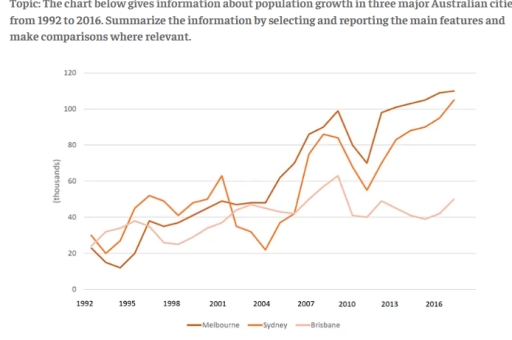
The image shows population growth (in thousands) from 1992 to 2016 for Melbourne, Sydney, and Brisbane. In 1992: Melbourne 20, Sydney 40, Brisbane slightly above 20. In 1993: Melbourne around 20, Sydney 40, Brisbane slightly below 20. In 1994: Melbourne below 40, Sydney around 25, Brisbane between 20-40. In 1995: Melbourne around 40, Sydney below 20, Brisbane below 40. In 1996: Melbourne around 40, Sydney below 40, Brisbane around 40. In 1997: Melbourne slightly above 40, Sydney around 25, Brisbane around 40. In 1998: Melbourne around 40, Sydney around 40, Brisbane below 40. In 1999: Melbourne above 40, Sydney around 40, Brisbane around 40. In 2000: Melbourne above 40, Sydney slightly above 40, Brisbane below 40. In 2001: Melbourne around 60, Sydney around 60, Brisbane below 40. In 2002: Melbourne 80, Sydney around 80, Brisbane slightly above 40. In 2003: Melbourne around 80, Sydney below 40, Brisbane around 60. In 2004-2005: Melbourne around 80, Sydney below 40, Brisbane below 40. In 2006: Melbourne around 100, Sydney above 60, Brisbane above 40. In 2007: Melbourne around 120, Sydney above 80, Brisbane around 40. In 2008: Melbourne around 120, Sydney above 40, Brisbane around 60. In 2009: Melbourne below 100, Sydney above 60, Brisbane around 60. In 2010: Melbourne below 100, Sydney below 60, Brisbane around 40. In 2011: Melbourne slightly above 100, Sydney below 80, Brisbane below 60. In 2012: Melbourne slightly below 120, Sydney slightly above 80, Brisbane below 60. In 2013: Melbourne around 120, Sydney around 100, Brisbane around 60. In 2014: Melbourne 100 to 80, Sydney below 80, Brisbane above 60. In 2015: Melbourne above 100, Sydney slight drop then up from slightly below 80 to around 100
Given the complexity of the image, the above description may not be entirely accurate.
Skyrocket your IELTS band score by 1-2 points in under a month with our premium plan!
Note: Both the topic and the answer were created by one of our users.
The line chart compares the number of population growth in three different major Australian cities between 1992 and 2016.
It is clear that the highest number of population growth was in the city of Melbourne in Australia in the year of 2016. By contrast, the number of population growth in Brisbane was the lowest in the given country and the year.
In the terms of population growth, there were a lot of ups and downs in those three cities of Australia among those cities Melbourne is in the highest position. In 1992 the population of Melbrourne was more than 20 thousand and it rose to 100 thousand in the between of 2007 and 2010. But suddenly the population broke down to less than 80 thousand and suprisingly the population again increased to more than 100 thousand in the year of 2016.
For the remaining cities, in Sydney the population was the same as Melbourne in the year of 1992 but then the population grew to more than 60 thousand and again droped to almost 20 thousand. Moreover, the population again filled up the gaps and increased to more than 100 thousand in 2016. On the other hand, in Brisbane in 1992 the population was around 25 thousand and it rose up to more than 40 thousand in 2016.
Word Count: 218
