Our system will evaluate the answer based on this AI-generated description.
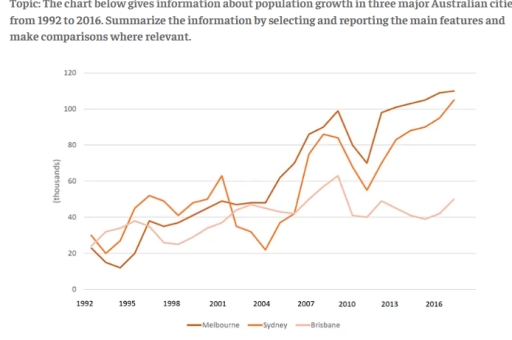
The image shows population growth (in thousands) from 1992 to 2016 for Melbourne, Sydney, and Brisbane. In 1992: Melbourne 20, Sydney 40, Brisbane slightly above 20. In 1993: Melbourne around 20, Sydney 40, Brisbane slightly below 20. In 1994: Melbourne below 40, Sydney around 25, Brisbane between 20-40. In 1995: Melbourne around 40, Sydney below 20, Brisbane below 40. In 1996: Melbourne around 40, Sydney below 40, Brisbane around 40. In 1997: Melbourne slightly above 40, Sydney around 25, Brisbane around 40. In 1998: Melbourne around 40, Sydney around 40, Brisbane below 40. In 1999: Melbourne above 40, Sydney around 40, Brisbane around 40. In 2000: Melbourne above 40, Sydney slightly above 40, Brisbane below 40. In 2001: Melbourne around 60, Sydney around 60, Brisbane below 40. In 2002: Melbourne 80, Sydney around 80, Brisbane slightly above 40. In 2003: Melbourne around 80, Sydney below 40, Brisbane around 60. In 2004-2005: Melbourne around 80, Sydney below 40, Brisbane below 40. In 2006: Melbourne around 100, Sydney above 60, Brisbane above 40. In 2007: Melbourne around 120, Sydney above 80, Brisbane around 40. In 2008: Melbourne around 120, Sydney above 40, Brisbane around 60. In 2009: Melbourne below 100, Sydney above 60, Brisbane around 60. In 2010: Melbourne below 100, Sydney below 60, Brisbane around 40. In 2011: Melbourne slightly above 100, Sydney below 80, Brisbane below 60. In 2012: Melbourne slightly below 120, Sydney slightly above 80, Brisbane below 60. In 2013: Melbourne around 120, Sydney around 100, Brisbane around 60. In 2014: Melbourne 100 to 80, Sydney below 80, Brisbane above 60. In 2015: Melbourne above 100, Sydney slight drop then up from slightly below 80 to around 100
Given the complexity of the image, the above description may not be entirely accurate.
Skyrocket your IELTS band score by 1-2 points in under a month with our premium plan!
Note: Both the topic and the answer were created by one of our users.
The line graph illustrates changes in population growth across Melbourne, Sydney and Brisbane over a 24-year period, from 1992 to 2016.
Overall, Melbourne experienced the most substantial and uninterrupted rise, eventually becoming the fastest-growing city. Sydney’s trend was far more volatile, while Brisbane showed only modest and steady increases throughout.
At the beginning of the period, population growth in Melbourne stood at roughly 20,000, lower than both Sydney and Brisbane, which each recorded around 30,000. However, by 1998, Melbourne overtook Brisbane and matched Sydney at approximately 50,000, despite a brief surge in Sydney’s figures to above 60,000.
From 2001 onwards, Melbourne’s growth accelerated markedly, rising from 40,000 to just under 90,000 by 2010, before reaching a peak of over 110,000 in 2016. In contrast, Sydney fluctuated significantly: it dropped to around 40,000 in the early 2000s, rebounded to nearly 70,000 in 2010, and then climbed more gradually to above 80,000 by the final year.
Brisbane, by comparison, remained the slowest-growing city. Its figures hovered between 30,000 and 40,000 for most of the period, with a slight rise towards 50,000 by 2016.
Word Count: 181
