🔥 Today Only: Save 30% on Premium — Offer Ends Soon! - Upgrade Now!
Bar Chart

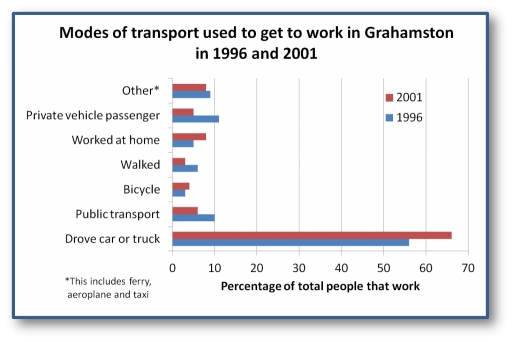
Band 6+: The chart below shows how people traveled to work in 1996 and 2001.

Image for topic: The chart below shows how people traveled to work in 1996 and 2001.
Our system will evaluate the answer based on this AI-generated description.
The image depicts a bar chart showing the percentage of total people that work in Grahamston using different modes of transport in 1996 and 2001, with a footnote mentioning that "Other*" includes ferry, aeroplane, and taxi. The x-axis measures from 0 to 70 in increments of 10 percentage points, and the y-axis lists modes of transport in descending order as follows: Drove car or truck, Public transport, Bicycle, Walked, Worked at home, Private vehicle passenger, and Other*. For 1996, the percentages are approximately: Drove car or truck 60%, Public transport 50%, Bicycle 20%, Walked 10%, Worked at home 5%, Private vehicle passenger 15%, Other* 5%. For 2001, the percentages are approximately: Drove car or truck 65%, Public transport 40%, Bicycle 13%, Walked 20%, Worked at home 8%, Private vehicle passenger 12%, Other* 3%. The bars are depicted in pairs for each mode of transport, with one bar representing 1996 and one bar representing 2001.
Given the complexity of the image, the above description may not be entirely accurate.
Note: Both the topic and the answer were created by one of our users.

The bar chart illustates the comperisons among the modes of transport used to get to work in Grahamston in 1996 and 2001.

Overall, most of the people used car or truck to get to work in both 2001 and 1996. In 2001 and 1996, the proportion of using bicycle and waking was lowest among all other transport, respectively.

In 1996, 56% people used to use cars or trucks to go to their workplace which rose sharply to 66% in 2001. The figure of public transport was 10% in 1996 which dropped sharply, decreasing to 6% in 2001. Use of bicycle recorded a marginal uptick, increasing from 3% to 4%. In 1996, 6% of the citizens used to go to their by walking. However, In 2001, it recorded a fractional drop to 3%.

Work from home was 5% in 1996 and it registered a modest upward shift to 8% in 2001. Private vehicles passengers was 11% in 1996 and witnessed a notable decline to 5%. Use of other vehicles such as ferry, aeroplane and taxi was 9% in 1996 and it recorded a marginal decline to 8% in 2001

Word Count: 188

Answers On The Same Topic:

The chart below shows how people traveled to work in 1996 and 2001.

THE BAR CHART ILLUSTRATES THE PROPORTION OF USED TRANSPORT TO GET TO WORK THROUGHOUT THE TIME PERIOD BETWEEN 1996 AND 2001. OVERALL, OVER ALL TIME PERIOD GIVEN WORKERS USED CARS AND TRUCKS MORE FREQUENTLY THEN OTHER TRANSPORTS. MOREOVER OTHER VARITIES OF WAY DO NOT EXCEEDED UNDER 20%. WITH REGARDS TO EMPLOYEES WHO DROVE CAR OR […]

The chart below shows how people traveled to work in 1996 and 2001.

The bar chart gives information about different types of transport used to commute to work in Grahamston in 1996 and 2001. Overall, car and truck emerged as the most prevalent modes of transport to get to work in 1996, and it increased by 2001, as did the proportions of people who cycled to work and […]

The chart below shows how people traveled to work in 1996 and 2001.

The bar chart illustrates the percentage of transport’s types used to get to work in grahamston over the 5 years period. Overall, it is clear that category “drove car or truck” in 2001 recorded with the highest figure, while “bycicle” in1996 and “walked” in 2001 showed the lowest point over the trend. In 1996, driving […]

The chart below shows how people traveled to work in 1996 and 2001.

The bar chart compares the percentage of transport usage in Grahamston over the period from 1996 to 2001. Overall, it is clear that Drove car or truck had the highest figures, while bicycle recorded the lowest. Another noticeable trend is that private vehicle passenger showed a higher percentage. In contrast, the walked presented the lower […]

The chart below shows how people traveled to work in 1996 and 2001.

The graph illustrates the proportion of people who go to work with distinct types of transportation during the given time. Overall, over the period from 1996 to 2001, people had a preference to go to work by car or truck while the other types of vehicles took up small minorities. In 1996, people who drove […]

See All

Other Topics:

The bar chart below represents the plastic waste generation in different regions (in million tons) from 1995 to 2020. Summarise the information by selecting and reporting the main features and make comparisons where relevant.

The bar chart illustrates the information regarding generation of plastic waste in million tons from 19995 to 2020 in four different regions (North America,Europe,Asia,South America). Overall,in first year south america was the least and north america highest.In some years north america and europe on the same number.The data measured in percentage. In 1995,North america was […]

The graph below gives information about the preferred leisure activities of Australian children.

The bar chart illustrates the percentages of Australian children who like to do five different activities in their free time. In general, Watching TV or videos was the most popular activity for both genders. In addtion, it is clearly apparent thay boys recorded higher participation rates in Electronic or computer games, Bike riding and Skateboarding […]

The bar chart shows the percentage of students in Country X who participated in football, basketball, tennis, and swimming in 2010 and 2020.

The bar chart demonstrates the changes in the proportion of the students that participate in various types of sport-football, basketball, tennis, and swimming -over the course of 10 years starting from 2010. Looking from all perspectives, it is crystally clear that the percentage of participation in football and basketball underwent general declines, whereas tennis and […]

the bar chart gives information about the phone usage among different age groups in a country from 1998 to 2000.

The bar chart compares people using mobile phones according to age groups in one country from 1998 to 2000. Overall, people from 31-50, and especially those between 16 – 30 were the primary user demographic in all years despite a noticeable fall in the figures. In contrast, there was an increase in the proportion of […]

The chart below shows the aid from six developed countries to developing countriesfrom 2008-2010. Summarize the information by selecting and reporting the mainfeatures, and make comparisons where relevant.

The bar chart illustrates the amount of aid provided by six prosperous countries to developing nations between 2008 and 2010, measured in billions of dollars. Overall, the US contributed by far the largest amount of aid throughout the period, while Sweden consistently provided the least. Most countries experienced fluctuations in their aid contributions over the […]

The bar chart shows clothing import prices to the EU from six countries in 1993 and 2003.

The bar chart indicated clothing import prices to the EU from six countries in 1993 and 2003. Overall, Argentina showed a highest rise in both years, followed by Brazil, while,China, India, along with Bangladesh the lowest positions, whereas Japen increased significantly afterwards. In 1993, the clothing import prices Argentina were the most well-known, cournty around […]

See All
We have detected unusual activity on your device.
Please verify your identity to continue.
Note: This verification step won't sign you in. If you have a premium account, please log in to access the service as usual.
Google/Gmail Verification
Or verify using Email/Code
We've sent a verification code to:
youremail@gmail.com (Not your email?)
Enter it below to complete the verification process.
Ensure your email address is correct, your inbox is not full, and you check your spam folder. If no email arrives, consider using an alternative email.
You will need a Premium plan to perform your action!
Note: If you already have a premium account, please log in to access our services as usual.

Plans & Pricing

Our mission is to make quality education accessible for everyone.
However, to keep our hardworking team running and this service alive, we genuinely need your support!
By opting for a premium plan, not only do you sustain us in achieving the mission, but you also unlock advanced features to enrich your learning experience.

Free

For learners who aren't pressed for time

What's included on Free
100+ Cambridge IELTS Tests
Instant IELTS Writing Task 1 & 2 Evaluation (2 times/month)
Instant IELTS Speaking Part 1, 2, & 3 Evaluation (2 times/month)
Instant IELTS Writing Task 1 & 2 Essay Generator (2 times/month)
500+ Dictation & Shadowing Exercises
100+ Pronunciation Exercises
Flashcards
Other Advanced Tools

Premium

For those serious about advancing their English proficiency, and for IELTS candidates aspiring to boost their band score by 1-2 points (especially in writing & speaking) in just 30 days or less

What's included on Premium
Save Your IELTS Test Progress & Analyze Mistakes By Question Type
Save Your Own Flashcard Sets & Use Them On Any Device
Unlock All Courses, IELTS Tests, Section & Part Practice
Unlimited AI Conversations
Unlimited AI Writing Enhancement Exercises
Unlimited IELTS Writing Task 1 & 2 Evaluation
Unlimited IELTS Speaking Part 1, 2, & 3 Evaluation
Checked Answers Will Not Be Published
Unlimited IELTS Writing Task 1 & 2 Essay Generator
Unlimited IELTS Speaking Part 1, 2, & 3 Sample Generator
Unlimited Usage Of Advanced Tools & AI Features
Priority Support within 24h (12-month plan only)

Due to the nature of our service and the provided free trials, payments are non-refundable.