Our system will evaluate the answer based on this AI-generated description.
The image shows data trends from 1962 to 2012 for Services, Manufacturing, Agriculture, Construction, and Mining; in 1962, Services at 40%, Manufacturing at 25%, Agriculture at 30%, Construction at approximately 3%, and Mining at 2%; in 1972, Services at 50%, Manufacturing at approximately 21%, Agriculture at 25%, Construction at 2%, and Mining at around 2%; in 1982, Services at 55%, Manufacturing at approximately 15%, Agriculture at 19%, Construction at 2%, and Mining at around 1%; in 1992, Services at 60%, Manufacturing at around 10%, Agriculture at 14%, Construction at approximately 2%, and Mining at around 1%; in 2002, Services at 70%, Manufacturing at approximately 7%, Agriculture at 11%, Construction at 2%, and Mining at less than 1%; in 2012, Services at around 78%, Manufacturing at 6%, Agriculture at 9%, Construction at around 2%, and Mining at less than 1%.
Given the complexity of the image, the above description may not be entirely accurate.
Skyrocket your IELTS band score by 1-2 points in under a month with our premium plan!
Note: Both the topic and the answer were created by one of our users.
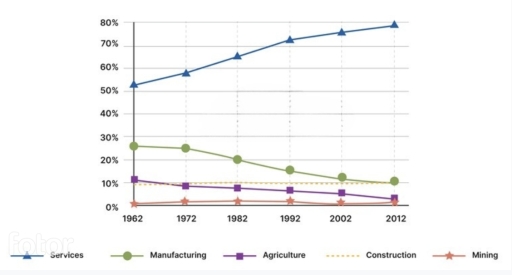
The line graph indicates the percentage of employees in five different industries in Australia over a period of 50 years.
Overall, Australian employees who work in services had the highest rate, at around 80%, among other sectors. However, workers in mining had the lowest percentage, at around 5%.
In terms of employees in services, the percentage began at around 50% and then increased to around 80% over the period. Likewise, the workforce in mining and agriculture began at around 0% and 10%, respectively, and they had the same rate, under 5%, in the year 2012.
Workers in the construction industry remained steady at 10% over time, in contrast to manufacturing and agriculture industries, which had dropped. Employees who work in manufacturing and construction industries started at different percentages, but in 2012 their numbers of employees were the same, at around 10%.
Word Count: 141
