Our system will evaluate the answer based on this AI-generated description.
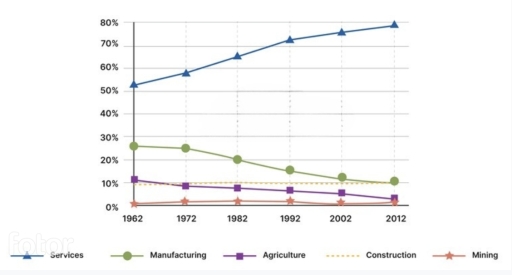
The image shows data trends from 1962 to 2012 for Services, Manufacturing, Agriculture, Construction, and Mining; in 1962, Services at 40%, Manufacturing at 25%, Agriculture at 30%, Construction at approximately 3%, and Mining at 2%; in 1972, Services at 50%, Manufacturing at approximately 21%, Agriculture at 25%, Construction at 2%, and Mining at around 2%; in 1982, Services at 55%, Manufacturing at approximately 15%, Agriculture at 19%, Construction at 2%, and Mining at around 1%; in 1992, Services at 60%, Manufacturing at around 10%, Agriculture at 14%, Construction at approximately 2%, and Mining at around 1%; in 2002, Services at 70%, Manufacturing at approximately 7%, Agriculture at 11%, Construction at 2%, and Mining at less than 1%; in 2012, Services at around 78%, Manufacturing at 6%, Agriculture at 9%, Construction at around 2%, and Mining at less than 1%.
Given the complexity of the image, the above description may not be entirely accurate.
Skyrocket your IELTS band score by 1-2 points in under a month with our premium plan!
Note: Both the topic and the answer were created by one of our users.
The presented illustration of the line graph demonstrates the proportion of the Australian workforce in five distinct sectors (services, manufacturing, agriculture, construction, and mining) in both years, from 1962 to 2012. Units are measured in percentages.
Overall, it can be clearly seen that all sections are decreased, while services was the only sector that experienced an upward trend.
At the beginning of the period, services makes up at just over 50%, and significantly increased to 72% in 1992, then gradually climbed to 80% at the end of the given period. In contrast, both construction and agriculture accounts for around 10% in 1962, then construction remained unchanged, however, agriculture slightly decreased to 0% in the year 2012. Likewise, throughout the period, there was no change in mining section. Moreover, manufacturing initially starts at approximately 28%, then it was dramatically declined to 10% in 2012.
Word Count: 143
