Our system will evaluate the answer based on this AI-generated description.
The image is a line graph titled "Survey results: reasons for moving" with the y-axis ranging from 10,000 to 100,000 and x-axis from 2000 to 2015 in 5-year increments; four lines represent different reasons - employment (lightest color), study (second lightest), family/friends (second darkest), adventure (darkest); employment line starts around 30,000 in 2000, gently rises to about 34,000 in 2005, steeply to about 65,000 in 2010, then more gently to just below 70,000 in 2015; study starts around 25,000 in 2000, gently rises to about 30,000 in 2005, steeply to about 57,000 in 2010, then more gently to just below 60,000 in 2015; family/friends starts around 12,000 in 2000, remains stable until 2005, rises slightly to about 15,000 in 2010, then sharply to about 40,000 in 2015; adventure starts around 20,000 in 2000, remains stable until 2005, rises slightly to about 22,000 in 2010, then steeply to about 85,000 in 2015.
Given the complexity of the image, the above description may not be entirely accurate.
Skyrocket your IELTS band score by 1-2 points in under a month with our premium plan!
Note: Both the topic and the answer were created by one of our users.
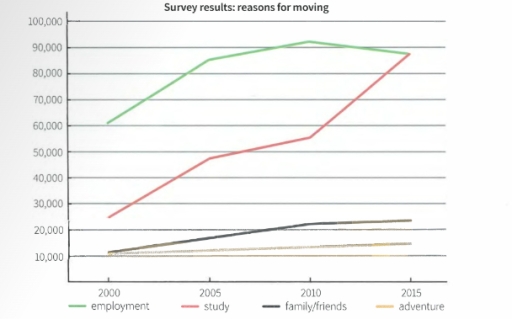
This graphic chart shows us some tendencies in people moving to a foreign country and their reasons for it.
Overall, we can see that there’s an upward trend in all lines of the chart. The most significant growth we can see in the nuber of people moving for study. In 2000 it reaches only below 30000 people compared to almost 90000 in 2015.
A similar increas is in the nuber of people moving for employment. It starts with 60000 in 2000 and levels off at around 90000 in 2015.
The number of people moving for their families or for adventures increases only slightly in 15 years: from 10000 to 20000 in moving for families and 10000 to 15000 in moving for adventure.
Word Count: 122
