Our system will evaluate the answer based on this AI-generated description.
The image is a graph with two y-axes, the left one representing population size in millions, from 0 to 55 in increments of 5, and the right one representing birth and death rate per 1,000 people, from 0 to 55 in increments of 5. The x-axis represents the years 1700 to 2000 in increments of 50. There are three lines, one solid and two dotted, representing population size, birth rate, and death rate, respectively. The solid line indicates population size remains steady at 5 million from 1700 to 1750, then rises gradually to 10 million by 1800, reaches 15 million in 1850, and then increases sharply reaching 30 million by 1900, 45 million by 1950, and peak over 50 million by 2000. The dotted lines indicate birth and death rates, with the birth rate starting around 40 per 1,000 people in 1700, increasing to 45 around 1750, then declining to 35 by 1800, fluctuating between 35 and 40 until 1900, then dropping sharply to slightly above 15 in 1950 and stabilizing around 10 in 2000. The death rate starts at 35 per 1,000 people in 1700, rises to 45 in 1750, then drops steeply to slightly above 20 by 1800, fluctuates between 20 and 25 until 1900, then declines sharply to approximately 10 in 1950 and maintains a consistent 10 in 2000.
Given the complexity of the image, the above description may not be entirely accurate.
Skyrocket your IELTS band score by 1-2 points in under a month with our premium plan!
Note: Both the topic and the answer were created by one of our users.
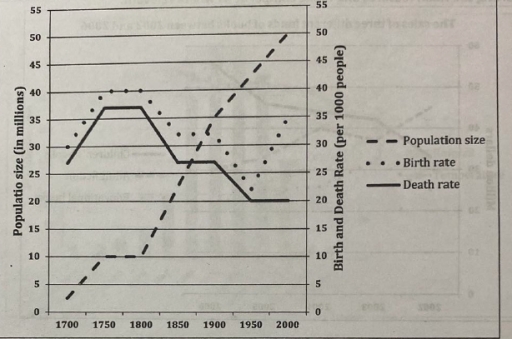
the line graph illustrates the information about three population demographic(population size, the birth rate and death rate in England and Wales between1700 to 2000.
overall, it is clear that, throughout the given period the birth rate was more than the death rate. Also the population size rose with time, while the death rate and birth rate fluctuated.
In detail the population of England and Wales stood at 3 million in 1700. Over the next five decades, the population rose to 10 million, but from 1750 to 1800, the population remained unchanged. After 1800, the population went up considerably and stood at 50 million in 2000.
In 1700, the birth rate and death rate were 30 and around 27 per 1000 people respectively. over 50 years both rate increased. However, after that till 1950, both fell down and in 1950, the birth rate was around 22 per 1000 and death rate was 20 per 1000 people. In the last fifty years, the birth rate went up and stood at 50 per 100 people in 2000, while the death rate remained constant at 20 per 1000 people.
Word Count: 185
