🔥 Today Only: Save 30% on Premium — Offer Ends Soon! - Upgrade Now!
Line Graph

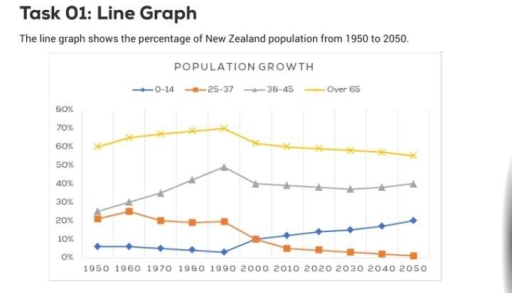
Band 5+: The line graph shows the percentage of New Zealand population from 1950 to 2050

Image for topic: The line graph shows the percentage of New Zealand population from 1950 to 2050
Our system will evaluate the answer based on this AI-generated description.
The image presents a line graph indicating population growth by age groups in New Zealand from 1950 to 2050; the age groups are 0-14, 25-37, 36-45, and over 65. In 1950, percentages for age groups were as follows: 0-14 at 45%, 25-37 at 25%, 36-45 at 20%, and over 65 at 10%. In 1960, 0-14 rose to 50%, 25-37 dropped to 20%, 36-45 remained at 20%, and over 65 increased to 15%. By 1970, all groups except 36-45 increased by 5% each, but by 1980, 0-14 declined to 40%, 25-37 grew to 30%, 36-45 stayed at 25%, and over 65 reached 20%. By 1990, 0-14 dropped to 35%, 25-37 slightly grew to 35%, 36-45 maintained at 20%, and over 65 rose to 25%. In 2000, 0-14 went down to 30%, 25-37 shrunk to 30%, 36-45 increased to 30%, and over 65 remained at 25%. In 2010, 0-14 further decreased to 25%, 25-37 went up to 40%, 36-45 slightly rose to 35%, and over 65 fell to 20%. The forecast for 2020 anticipates 0-14 at 20%, 25-37 at 45%, 36-45 at 40%, and over 65 at 30%. By 2030, 0-14 is expected to continue at 20%, 25-37 at 55%, and 36-45 at 40%, with over 65 projected to hit 35%. In 2040, predictions suggest 0-14 remaining at 20%, 25-37 peaking at 60%, 36-45 staying at 40%, and over 65 climbing to 45%. Lastly, the 2050 outlook projects 0-14 at 20%, 25-37 reducing to 55%, 36-45 maintaining at 35%, and over 65 surging to 50%.
Given the complexity of the image, the above description may not be entirely accurate.
Note: Both the topic and the answer were created by one of our users.

The given line chart depicts the proportion of different ages in New Zealand between 1950 and 2050.

In general, there was an increase in the percentage of 0-14 years old and 38-45 years old, while a considerable decline was seen for 25-37 years old and over 65 years old. The number of people age over 65 years old make up the largest percentage throughout the period, while the figure for 0-14 years old seem to occupy the least percentage.

To begin with, upward of 60% people aged over 65 in 1950 in New Zealand, with a gradual rise to exactly 70% in 1990 and are expected to drop around 55% after 60 years. In a lesser extent, the number of people aged 38-45 years old also see dramatic change from around 25% in 1950 to approximately 50% in 1990, before being anticipated to decrease to 40% in 2050.

Regarding people from 25-37 years old, this figure was likely to decline from roughly 20% in 1950 to 10% in 1990, before its expectation to reach a trough of nearly 0% at the end of the period. Starting with lower extent, the figure for 0-14 years old saw slight decrease in the first 40 years, before it is expected to rise sharply to precisely 20% in 2050, which overtake the percentage of people ranging from 25-37 years old during the time frame.

Word Count: 230

Answers On The Same Topic:

The line graph shows the percentage of New Zealand population from 1950 to 2050

The line graph illustrates the percentage of New Zealand’s population in different age groups between 1950 and 2050. Overall, it can be seen that the proportion of older people is expected to rise significantly, while the percentage of younger age groups will decline over the period. This indicates an ageing population in New Zealand. In […]

The line graph shows the percentage of New Zealand population from 1950 to 2050

The chart illustrates the proportion of the Australian workforce employed in five different industries between 1962 and 2012. Overall, while employment in the services, mining, and construction sectors increased over the period, the proportions of workers in manufacturing and agriculture showed a steady decline. Throughout the timeframe, the services industry consistently accounted for the largest […]

The line graph shows the percentage of New Zealand population from 1950 to 2050

The chart gives information about the portion of the Australian labour force recruited in five distinct industries between 1962 and 2012. Overall, while the employment rate of services, mining and construction witnessed an upward trend, that of manufacturing and agriculture experienced an opposite situation. Additionally, the percentage of workforce in services remained the highest over […]

The line graph shows the percentage of New Zealand population from 1950 to 2050

The two maps illustrate how the museum has changed since 1998. Overall, it is evident that the museum has transformed dramatically, with the introduction of new facilities and the relocation of rooms. In 1998, visitors could enter the museum from the entrance in the south. On the left of the museum stood a permanent exhibition […]

The line graph shows the percentage of New Zealand population from 1950 to 2050

TThe line graph illustrates the proportion of people in New Zealand across four different age groups from 1950 to 2050. Overall, the percentage of those aged over 65 experienced a steady upward trend over the whole period, while the proportion of those aged 25-37 is expected to decline significantly. However, the percentage of people aged […]

See All

Other Topics:

The line graph below shows the electricity consumption in four different sectors (A, B, C, and D) between 2005 and 2020, measured in terawatt hours (TWh).

The line graph illustrates the consumption by four sectors during the period from 2005 to 2020. Overall, it is obvious that the amount of electricity consumed by sector A and D witnessed a steady increase, whereas the figure by sector B experienced a gradual decline over the period shown. Besides, that of sector C showed […]

The graph below shows the information about green transportation users from 1980 to 2020.

The line graph compares the number of monthy commuters traveling by 4 different types of transportation including subway, bus, tram ; and bike share over a period of 50 years from 1980 to 2030. As an overall trend it can be clearly seen that subway had the highest level of commuters over the time while […]

The grapgh below shows China's population by age group starting in 1960 and including forecast to 2050.

The graph above demonstrates the changes in the number of people grouped by different intervals of ages in China since 1960 and including a forecast to 2050. Overall, people aged between 15 and 64 are the most populated group in China while it is expected that the number of elderly people will exceed that of […]

Describe the graph shows the number of books read by men and women

The line graph compares the number of books read by men and women at Burnaby Public Library from 2011 to 2014. Overall, the number of books read by men increased gradually over the period. It is also noticeable that the figure for female readers increased initially but declined by the end of the period. In […]

The graph below shows the number of overseas visitors to three different areas of a European country between 1987 and 2007.

The line chart illustrates the number of overseas visitors to three various areas of a European country from 1987 to 2007. Overall, the coast area had the most visitors over the time of period. By contrast, the number of visitors of the lakes were the lowest at beginning and increased significantly over the period. In […]

Summarise the information by selecting and reporting the main features, and make comparison where relevent

The line graph illustrates varous activities at one social centre and their amount of participants in Melbourne, Australia between 2000 to 2020. It is evident that the most people participanted for film club among other activities despite of being stable over twenty years. Moreover, number of musical performances and that of table tennis increased. However, […]

See All
We have detected unusual activity on your device.
Please verify your identity to continue.
Note: This verification step won't sign you in. If you have a premium account, please log in to access the service as usual.
Google/Gmail Verification
Or verify using Email/Code
We've sent a verification code to:
youremail@gmail.com (Not your email?)
Enter it below to complete the verification process.
Ensure your email address is correct, your inbox is not full, and you check your spam folder. If no email arrives, consider using an alternative email.
You will need a Premium plan to perform your action!
Note: If you already have a premium account, please log in to access our services as usual.

Plans & Pricing

Our mission is to make quality education accessible for everyone.
However, to keep our hardworking team running and this service alive, we genuinely need your support!
By opting for a premium plan, not only do you sustain us in achieving the mission, but you also unlock advanced features to enrich your learning experience.

Free

For learners who aren't pressed for time

What's included on Free
100+ Cambridge IELTS Tests
Instant IELTS Writing Task 1 & 2 Evaluation (2 times/month)
Instant IELTS Speaking Part 1, 2, & 3 Evaluation (5 times/month)
Instant IELTS Writing Task 1 & 2 Essay Generator (2 times/month)
500+ Dictation & Shadowing Exercises
100+ Pronunciation Exercises
Flashcards
Other Advanced Tools

Premium

For those serious about advancing their English proficiency, and for IELTS candidates aspiring to boost their band score by 1-2 points (especially in writing & speaking) in just 30 days or less

What's included on Premium
Save Your IELTS Test Progress
Unlock All Courses & IELTS Tests
Unlimited AI Conversations
Unlimited AI Writing Enhancement Exercises
Unlimited IELTS Writing Task 1 & 2 Evaluation
Unlimited IELTS Speaking Part 1, 2, & 3 Evaluation
Checked Answers Will Not Be Published
Unlimited IELTS Writing Task 1 & 2 Essay Generator
Unlimited IELTS Speaking Part 1, 2, & 3 Sample Generator
Unlimited Usage Of Advanced Tools
Priority Support within 24h (12-month plan only)

Due to the nature of our service and the provided free trials, payments are non-refundable.
Nếu bạn là người Việt Nam và không có hoặc không muốn trả bằng credit/debit cards, bạn có thể thanh toán bằng phương thức chuyển khoản:


Chọn gói:
419,000₫ 277,000 ₫ cho gói 1 tháng (chỉ 9,233₫/ngày)
1,239,000₫ 597,000 ₫ cho gói 3 tháng (chỉ 6,633₫/ngày)
2,469,000₫ 1,027,000 ₫ cho gói 6 tháng (chỉ 5,706₫/ngày)
4,929,000₫ 1,417,000 ₫ cho gói 12 tháng (chỉ 3,936₫/ngày)


Sau khi chuyển khoản, vui lòng đợi trình duyệt tự động điều hướng bạn trở lại Engnovate và bạn sẽ ngay lập tức nhận được mã kích hoạt tài khoản premium.
Nếu có lỗi xảy ra, bạn có thể liên hệ với team thông qua một trong các phương thức: email đến helloengnovate@gmail.com hoặc nhắn tin qua facebook.com/engnovate.
Vì toàn bộ công cụ trên website đều có thể sử dụng thử miễn phí, Engnovate không hỗ trợ hoàn tiền.