Our system will evaluate the answer based on this AI-generated description.
The image presents a line graph from 2000 to 2014 detailing numerical data for four entities: China, European Union, Asia (without China), and USA. In 2000, China starts at 8, European Union at 28, Asia (without China) at 26, and USA at 12. By 2002, China reaches 10, European Union at 26, Asia (without China) at 22, and USA at 11. In 2004, China's data moves to 15, European Union sits at 24, Asia (without China) at 19, and USA at 10. By 2006, China edges up to 19, European Union remains at 23, Asia (without China) remains steady at 19, and USA slightly lowers to 9. The 2008 data shows China at 23, European Union continuing at 23, Asia (without China) consistent at 19, USA at 9. In 2010, China advances to 27, European Union decreases to 21, Asia (without China) is steady at 19, and USA slightly dips to 8. By 2012, China records 32, European Union decreases to 20, Asia (without China) at 20, and USA charts 7. In 2014, China tops at 36, European Union stabilizes at 20, Asia (without China) at 21, and USA declines further to 6.
Given the complexity of the image, the above description may not be entirely accurate.
Skyrocket your IELTS band score by 1-2 points in under a month with our premium plan!
Note: Both the topic and the answer were created by one of our users.
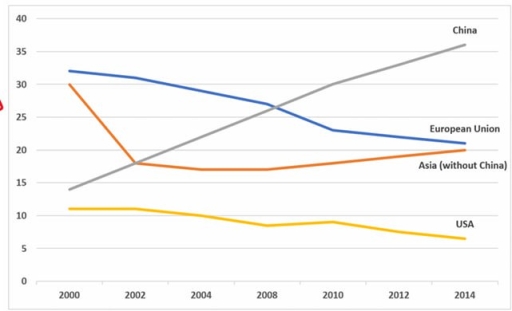
The line graph illustrates the percentage of clothing exported by the USA, European Union, China and the rest of Asia over a fourteen-year period, from 2000 to 2014.
Overall, what stands out from the graph is that the figures for Europe, Asia (excluding China) and USA showed downward trends over the period in question, whereas the reverse was true for China. It is also clear that during the first half of the period, the European Union exported the highest proportion of clothing, but was overtaken by China by the end of the period. In addition, the USA maintained the lowest clothing export percentages throughout the period.
To begin with, clothing export figures for both the USA and China were almost on par, with around 11% and 14% respectively. After a period of stability between 2000 and 2002, the USA’s clothing exports almost halved to 6%, but that of China increased substantially, reaching a chart high of just over 35% in 2014.
Similarly, the percentage of clothing exported by both continents was nearly equal, with EU’s 32% and Asia’s 30% in 2000. However, both continents saw significant drops to around 20% during the period, despite being top clothing exporters at the beginning. As a result, the gap between these two continents was slightly narrower compared to the year 2000.
Word Count: 218
