Our system will evaluate the answer based on this AI-generated description.
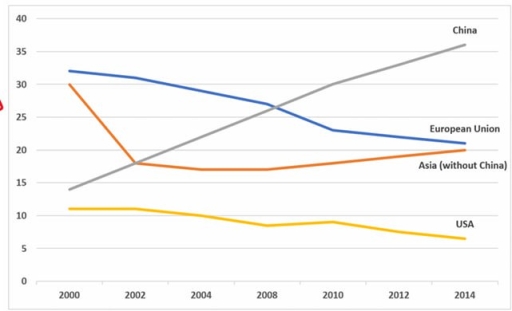
The image presents a line graph from 2000 to 2014 detailing numerical data for four entities: China, European Union, Asia (without China), and USA. In 2000, China starts at 8, European Union at 28, Asia (without China) at 26, and USA at 12. By 2002, China reaches 10, European Union at 26, Asia (without China) at 22, and USA at 11. In 2004, China's data moves to 15, European Union sits at 24, Asia (without China) at 19, and USA at 10. By 2006, China edges up to 19, European Union remains at 23, Asia (without China) remains steady at 19, and USA slightly lowers to 9. The 2008 data shows China at 23, European Union continuing at 23, Asia (without China) consistent at 19, USA at 9. In 2010, China advances to 27, European Union decreases to 21, Asia (without China) is steady at 19, and USA slightly dips to 8. By 2012, China records 32, European Union decreases to 20, Asia (without China) at 20, and USA charts 7. In 2014, China tops at 36, European Union stabilizes at 20, Asia (without China) at 21, and USA declines further to 6.
Given the complexity of the image, the above description may not be entirely accurate.
Skyrocket your IELTS band score by 1-2 points in under a month with our premium plan!
Note: Both the topic and the answer were created by one of our users.
The line graph shows how many million tonnes of tree forest industry materials were produced between 1980 and 2000, over five year time intervals. Overall, production of all the products was increased by the end of the period. It is also clear that production of paper and pulp witnesssed steady and significant increase, whilst timber production was volitile, peaking in 1985 before declining.
Timber was the dominant product in first decade. Starting with 5 million tonnes, output of timber was slightly ahead of pulp and paper. It experienced a sharp rise to 10 million tonnes, reaching it’s peak, tough this trend did not countinued, it declined significantly after 1985 and experienced fluctuations throughout the rest of the period, eventually droping to about 6 million tonned in 2000.
In contrast, paper and pulp followed more consistent upward trends. Pulp started at around 5 million tonnes in 1980 and experiences slow but steady increase, rising to approximately 9 million tonnes by the end of the period. Similarly, paper initially had the lowest output, about 4 million tonned in 1980, grew constantly over the two decates and eventually surpassing both pulp and timber production in mid-1990 and ended the period as the most produced product, reaching nearly 12 million tonnes
Word Count: 207
