Our system will evaluate the answer based on this AI-generated description.
The image presents a line graph from 2000 to 2014 detailing numerical data for four entities: China, European Union, Asia (without China), and USA. In 2000, China starts at 8, European Union at 28, Asia (without China) at 26, and USA at 12. By 2002, China reaches 10, European Union at 26, Asia (without China) at 22, and USA at 11. In 2004, China's data moves to 15, European Union sits at 24, Asia (without China) at 19, and USA at 10. By 2006, China edges up to 19, European Union remains at 23, Asia (without China) remains steady at 19, and USA slightly lowers to 9. The 2008 data shows China at 23, European Union continuing at 23, Asia (without China) consistent at 19, USA at 9. In 2010, China advances to 27, European Union decreases to 21, Asia (without China) is steady at 19, and USA slightly dips to 8. By 2012, China records 32, European Union decreases to 20, Asia (without China) at 20, and USA charts 7. In 2014, China tops at 36, European Union stabilizes at 20, Asia (without China) at 21, and USA declines further to 6.
Given the complexity of the image, the above description may not be entirely accurate.
Skyrocket your IELTS band score by 1-2 points in under a month with our premium plan!
Note: Both the topic and the answer were created by one of our users.
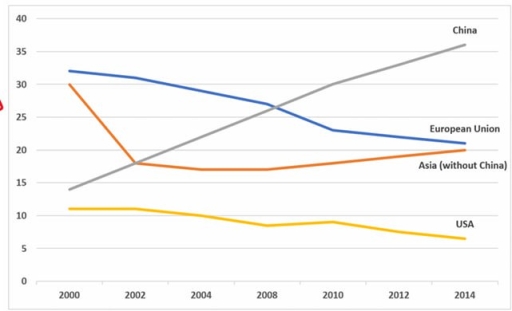
The line graph compares the percentages of clothing exported by four major figures in the global manufacturing between 2000 and 2014. Overall, the share of China followed the most exponential growth and became the global clothing manufacturing power over the period, despite a relatively small proportion initially. However, the opposite trend was the case for the other regions’ clothing exports, with the USA consistently falling behind the other regions.
China’s contribution to the global clothing export experienced the largest growth over the 14-year period. Standing at just under 15% in 2000, the figure started to take off over the following years. After a constant rise, it reached a high of over 35%, surpassing all the other figures.
The rest of Asia and the EU also showed significant proportions. In 2000, the share of Asia (excluding China) made up a substantial 30%, while that of the EU was slightly higher. By 2014, both figures had declined by 10%, albeit at varying manners.
Lastly, the relatively smaller clothes exporter was the USA. Accounting for a little over 10% in 2000, the figure for the USA fell towards the end of the period, maintaining the least dominant position in the global clothes exports.
Word Count: 200
