Our system will evaluate the answer based on this AI-generated description.
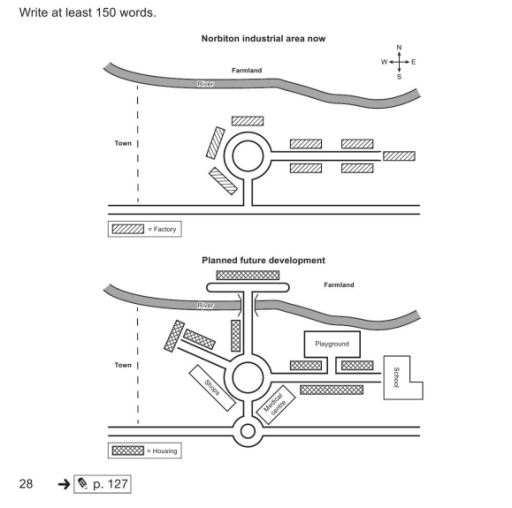
The image provides two diagrams: one illustrating the current state of the Norbiton industrial area, and the other showing the planned future development of the same area. In the current state, the diagram shows the industrial area composed primarily of factories, located to the north of a town (deemed "Town" in the diagram), and adjacent to farmland stretching towards the east. In the future development plan, the industrial area appears to be undergoing transformation with the addition of housing to the west of the factories, a playground to the north, surrounded by additional housing, and the farmland remaining largely untouched. The road system in both diagrams displays a roundabout with a single road branching directly from it towards the east, with the road labeled [20'9"']. Both diagrams orient Northwards and employ conventional map symbols: solid rectangles to denote factories, grid patterns for housing, and dotted outline to indicate a playground, with the remaining area assumed to represent farmland. No numerical data points, percentages, or specific quantitative measures aside from the road label "[20'9"] are provided.
Given the complexity of the image, the above description may not be entirely accurate.
Skyrocket your IELTS band score by 1-2 points in under a month with our premium plan!
Note: Both the topic and the answer were created by one of our users.
The two maps illustrate the current layout of the industrial area in Norbiton and its planned future development.
In the first map, the present Norbiton area consists of a total of eight factories. The farm and the river are located to the north, while the town is situated to the west of the industrial area. Notably, there are no residential or commercial spaces in the current layout. The road design is simple, with a roundabout at the center and the main road to the south of the area. There is ample space available for the addition of more buildings if necessary.
In contrast, the second map shows significant changes. The factories have been completely removed, and the area now includes housing and commercial buildings. The road network has been expanded, with an additional junction added. A bridge has been constructed over the river to connect the farmland to the north, which has been developed into a residential area. Unlike the first map, the north side of the area is now used for housing, which was previously farmland.
In conclusion, the two maps depict vastly different uses of the same area, with one focusing on industrial development and the other on residential and commercial expansion.
Word Count: 204
