Our system will evaluate the answer based on this AI-generated description.
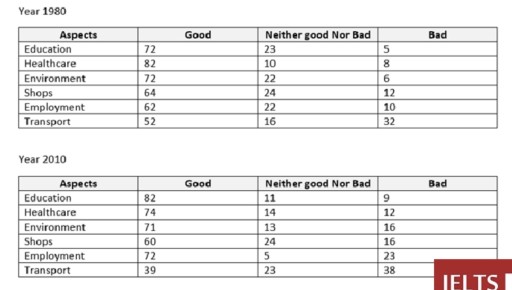
The image shows two tables comparing people's perceptions of various aspects of living conditions in 1980 and 2010. In 1980, the percentages for "good" are: education (72), healthcare (82), environment (72), shops (64), employment (62), and transport (52). The "neither good nor bad" percentages are: education (23), healthcare (20), environment (22), shops (22), employment (22), and transport (16). The "bad" percentages are: education (5), healthcare (8), environment (6), shops (10), employment (10), and transport (32). In 2010, the "good" percentages are: education (82), healthcare (74), environment (71), shops (60), employment (72), and transport (39). The "neither good nor bad" percentages are: education (11), healthcare (14), environment (13), shops (24), employment (5), and transport (23). The "bad" percentages are: education (9), healthcare (12), environment (16), shops (16), employment (23), and transport (38).
Given the complexity of the image, the above description may not be entirely accurate.
Skyrocket your IELTS band score by 1-2 points in under a month with our premium plan!
Note: Both the topic and the answer were created by one of our users.
The tables provide information regarding consequences of 2 surveys which was done in 1980 and 2010. Overall, it is obvious that increase of proportion of “bad” was observed in all given aspects from 1980 to 2010. The figures for “good” increased in education and employment throughout 3 decades, while the opposite is true for the others.
Looking at the tables, In terms of education, “good” stood at 72% in 1980, and make up the highest percentage with a steady climb in 2010, at 82%. The figures for “bad” increased by 4%, while the percentage of “neither good Nor bad” declined from 23% to 11%. In terms of employment, both “bad” and “good” rose by approximately 10%, and reached to 72% and 23% respectively, followed by “Neither good Nor bad”, accounting for 5% which is the lowest proportion among all given aspects.
Turning to others, slight differences were noticed in environment and shops. Whereas the proportion of “good” fell gradually, percentage of “bad” picked up moderately until 2010. In healthcare and transport the share of “Neither good Nor bad” and “bad” saw a minimal growth by nearly 5%, while the opposite is true for “good”.
Word Count: 194
