Our system will evaluate the answer based on this AI-generated description.
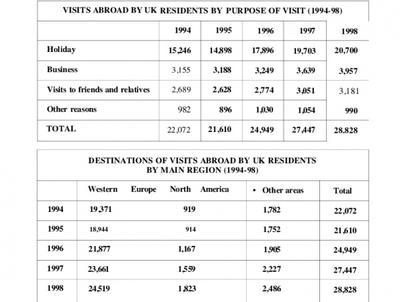
The image presents two tables regarding visits abroad by UK residents from 1994 to 1998. The first table, "VISITS ABROAD BY UK RESIDENTS BY PURPOSE OF VISIT (1994-98)", details visits for 1994, 1995, 1996, 1997, and 1998 respectively: Holiday (15,246, 14,898, 17,896, 19,703, 20,700), Business (3,155, 3,188, 3,249, 3,639, 3,957), Visits to friends and relatives (2,689, 2,628, 2,774, 3,051, 3,181), and Other reasons (982, 896, 1,030, 1,054, 990), with total visits per year being 22,072, 21,610, 24,949, 27,447, and 28,828. The second table, "DESTINATIONS OF VISITS ABROAD BY UK RESIDENTS BY MAIN REGION (1994-98)", provides a regional breakdown for the same years: Western Europe (19,371, 18,944, 21,877, 23,661, 24,519), North America (919, 914, 1,167, 1,559, 1,823), and Other areas (1,782, 1,752, 1,905, 2,227, 2,486), with the same corresponding total visits per year.
Given the complexity of the image, the above description may not be entirely accurate.
Skyrocket your IELTS band score by 1-2 points in under a month with our premium plan!
Note: Both the topic and the answer were created by one of our users.
The provided bar graph illustrates the average Australian annual residential water consumption in six different cities. While the pie chart shows the water distribution in 2014. These are divided into seven categories. The unit is measured in percentage.
In terms of cities, Perth had the highest water utilization, reaching 300 kiloliters per property. Followed by Adelaide and Brisbane, which had the second highest with slightly the same at 250 kiloliters. Sydney recorded around 200 kiloliters. Melbourne and Canberra had the least consumption, approximately 150 kiloliters.
Among water distribution, around 67% of water was used in agriculture. Households made up 9%. Moreover, water supply and drainage accounted for 7%, the same as electricity and gas supply. Manufacturing and other industries were at 4% each, and mining had a minimal share of just 2%.
Overall, residential consumption in various cities were relatively low in terms of national portion, whereas the farming sector was dominant in water consumption.
Word Count: 155
