Our system will evaluate the answer based on this AI-generated description.
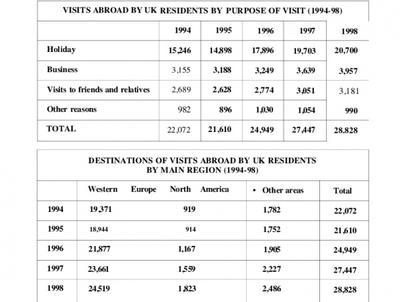
The image presents two tables regarding visits abroad by UK residents from 1994 to 1998. The first table, "VISITS ABROAD BY UK RESIDENTS BY PURPOSE OF VISIT (1994-98)", details visits for 1994, 1995, 1996, 1997, and 1998 respectively: Holiday (15,246, 14,898, 17,896, 19,703, 20,700), Business (3,155, 3,188, 3,249, 3,639, 3,957), Visits to friends and relatives (2,689, 2,628, 2,774, 3,051, 3,181), and Other reasons (982, 896, 1,030, 1,054, 990), with total visits per year being 22,072, 21,610, 24,949, 27,447, and 28,828. The second table, "DESTINATIONS OF VISITS ABROAD BY UK RESIDENTS BY MAIN REGION (1994-98)", provides a regional breakdown for the same years: Western Europe (19,371, 18,944, 21,877, 23,661, 24,519), North America (919, 914, 1,167, 1,559, 1,823), and Other areas (1,782, 1,752, 1,905, 2,227, 2,486), with the same corresponding total visits per year.
Given the complexity of the image, the above description may not be entirely accurate.
Skyrocket your IELTS band score by 1-2 points in under a month with our premium plan!
Note: Both the topic and the answer were created by one of our users.
The provided table illustrates the number and percentage of people at a Canadian university who have taken online courses. These are divided into two different categories: under 25 and over 25. The unit is measured in number.
In detail, those under age 25, around 10% (79) of students who have never taken an online course, and those who have taken 1 online course have 20% (160) candidates. Moreover, approximately 32% (256) of learners have taken 2 digital courses. Additionally, 22% (172) have taken three and 16% (130) have taken four or more e-learning materials.
On the other hand, among those over 25, 41% (180) of students have never taken online courses, which is the highest among all categories. Followed by around 21% (90) of people who have joined one or 2 digital courses. Meanwhile, only 7% (31) of participants have completed 4 or more e-learns.
In conclusion, students under age 25 has more engaged in e-learning campared to those over age of 25.
Word Count: 163
