Our system will evaluate the answer based on this AI-generated description.
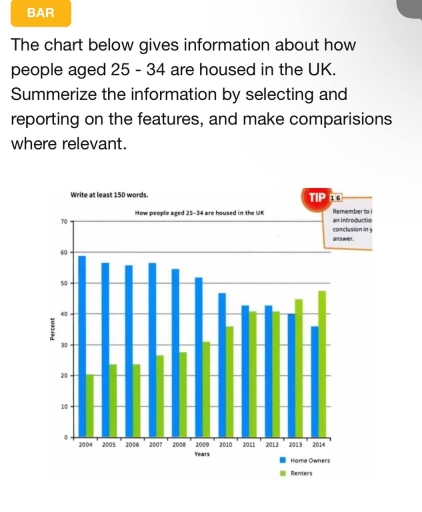
The image depicts a bar chart showing UK housing statistics for individuals aged 25-34 from 2004 to 2014, with "Home Owners" and "Renters" as categories; in 2004, home ownership stood at approximately 59% and renting at around 21%; in 2005, home ownership was close to 57% and renting at about 22%; in 2006, home ownership approximately 56% and renting at about 23%; in 2007, home ownership near 54% and renting about 24%; in 2008, home ownership at roughly 53% and renting around 26%; in 2009, home ownership approximately 50% and renting at 28%; in 2010, home ownership around 48% and renting at 31%; in 2011, home ownership approximately 45% and renting at 34%; in 2012, home ownership near 43% and renting about 36%; in 2013, home ownership close to 41% and renting around 38%; in 2014, home ownership stood at 36% and renting at 48%.
Given the complexity of the image, the above description may not be entirely accurate.
Skyrocket your IELTS band score by 1-2 points in under a month with our premium plan!
Note: Both the topic and the answer were created by one of our users.
The bar chart illustrates the information about how people aged from 25 to 34 are housed whether they are renters or home owners in the United Kingdom for a period of 10 year from 2004 to 2014.
Overall, it can be seen that the home owners scored by far the most percent for almost all the period. Whereas, the percentage of renters increased significatly over the years to became the leader by 2014.
The amount of renters started with 20% by 2004, while, the house owners constitued 60%.
Moreover, the amount of renters continued to rise to equal approximately the pecentage of home owners by 2011 and 2012 with 40%, it reached its peak by 2014 with almost 50%.
Meanwhile, the house owners constitued the biggest share until 2013 when it reached 40% to leave the renters in the top, it kept increasing in the following year to finally reach approximately 35%.
Word Count: 152
