Our system will evaluate the answer based on this AI-generated description.
The image features two line and bar graphs; in the "Equatorial Climate" graph, monthly rainfall and temperature data are shown as follows: January rainfall ~250mm, temperature 27°C; February rainfall ~230mm, temperature 27°C; March rainfall ~200mm, temperature 27°C; April rainfall ~225mm, temperature 26°C; May rainfall ~225mm, temperature 26°C; June rainfall ~150mm, temperature 25°C; July rainfall ~150mm, temperature 25°C; August rainfall ~150mm, temperature 26°C; September rainfall ~175mm, temperature 26°C; October rainfall ~225mm, temperature 27°C; November rainfall ~250mm, temperature 27°C; December rainfall ~275mm, temperature 27°C. In the "Mediterranean Climate" graph, January rainfall ~100mm, temperature 5°C; February rainfall ~50mm, temperature 7°C; March rainfall ~45mm, temperature 10°C; April rainfall ~50mm, temperature 13°C; May rainfall ~35mm, temperature 17°C; June rainfall ~15mm, temperature 20°C; July rainfall ~5mm, temperature 23°C; August rainfall ~5mm, temperature 24°C; September rainfall ~30mm, temperature 21°C; October rainfall ~90mm, temperature 17°C; November rainfall ~130mm, temperature 10°C; December rainfall ~130mm, temperature 5°C.
Given the complexity of the image, the above description may not be entirely accurate.
Skyrocket your IELTS band score by 1-2 points in under a month with our premium plan!
Note: Both the topic and the answer were created by one of our users.
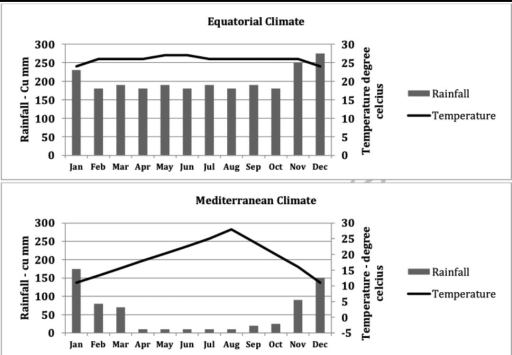
The given charts demonstrate annual weather temperature and rainfall in Equatorial climate and Mediterranean climate.
Overall, it is clear that the rainfall increases in both climates at the beginning and the end of the year, although the average rainfall in the equatorial climate is much higher than the mediterranean climate. Whereas, the temperature fluctuates in mediterranean climate.
In equatorial climate, it rains around 270 Cu mm during January; however, the figure declines to under 200 Cu mm by February and remains steady between 175 Cu mm to almost 200 Cu mm until October. After October, the figure increases sharply to 250 Cu mm by November and around 275 Cu mm by December. In addition, the temperature of the equatorial climate stays under 25 degrees Celsius at the beginning of the year; then the temperature goes up slightly to over 25 and fluctuates between 26 and 27 degree Celsius from February to October. Finally, the temperature drops slowly under 25 degrees by November and December.
In terms of Mediterranean climate, during January to August, the temperature increases dramatically from under 10 degrees to almost 28 degrees Celsius, whereas the figure of rainfall declines sharply from around 175 Cu mm to around 10 Cu mm. After August, the figure of rainfall significantly increases, reaching 150 Cu mm by December. In contrast, the temperature falls significantly from around 28 degrees to under 25 (at 13 to 14) degrees Celsius between August and December.
Word Count: 240
