Our system will evaluate the answer based on this AI-generated description.
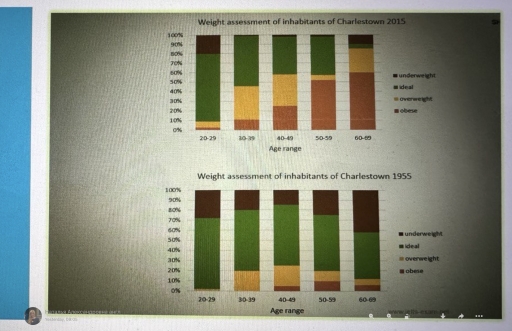
The image has two stacked bar graphs labeled "Weight assessment of inhabitants of Charlestown 2015" and "Weight assessment of inhabitants of Charlestown 1955"; both have the same five categories for age range '20-29', '30-39', '40-49', '50-59', '60-69' on the x-axis and a vertical percentage scale from 0% to 100% on the y-axis, divided into four weight categories 'underweight', 'ideal', 'overweight', 'obese'. The 2015 graph data: '20-29' age range 15% underweight, 20% ideal, 45% overweight, 20% obese; '30-39' age range 10% underweight, 25% ideal, 40% overweight, 25% obese; '40-49' age range 5% underweight, 20% ideal, 50% overweight, 25% obese; '50-59' age range 5% underweight, 25% ideal, 45% overweight, 25% obese; '60-69' age range no underweight, 30% ideal, 40% overweight, 30% obese. The 1955 graph data: '20-29' age range 40% underweight, 40% ideal, 15% overweight, 5% obese; '30-39' age range 30% underweight, 45% ideal, 20% overweight, 5% obese; '40-49' age range 20% underweight, 50% ideal, 25% overweight, 5% obese; '50-59' age range 10% underweight, 55% ideal, 25% overweight, 10% obese; '60-69' age range 5% underweight, 50% ideal, 35% overweight, 10% obese.
Given the complexity of the image, the above description may not be entirely accurate.
Skyrocket your IELTS band score by 1-2 points in under a month with our premium plan!
Note: Both the topic and the answer were created by one of our users.
The bar chart illustrates the weight assessment of people in different age groups living in Charlestown in 1995 and 2015.
Overall, in 1995, most people in all age groups were in the ideal weight category, while in 2015, there was a noticeable increase in overweight and obese individuals, especially in older age groups. The percentage of underweight people decreased over time.
In 1955, the ideal weight category accounted for about 70% of individuals aged 30 to 59, while the 20–29 and 60–69 groups had slightly lower rates, around 60%. Underweight was the second most common status among the youngest and oldest groups, at approximately 20%, while obesity remained rare, below 5% in all groups.
By contrast, in 2015, the proportion of obese individuals increased sharply. In the 60–69 age group, obesity reached nearly 60%, becoming the dominant category. Similarly, about half of those aged 50–59 were obese. The percentage of people at an ideal weight declined in all groups, dropping to around 20% in older adults. Underweight levels also fell, remaining below 10% across all ages.
Word Count: 176
