Our system will evaluate the answer based on this AI-generated description.
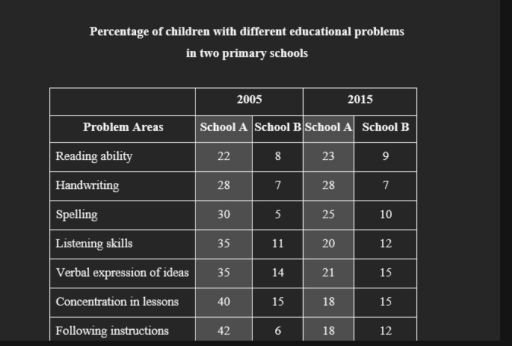
The image presents a table with data on the percentage of children with different educational problems in two primary schools across two years, 2005 and 2015. Problem areas are divided into Reading ability, Handwriting, Spelling, Listening skills, Verbal expression of ideas, Concentration in lessons, and Following instructions. School A in 2005 shows 22% in Reading ability, 28% in Handwriting, 30% in Spelling, 35% in Listening skills, 35% in Verbal expression of ideas, 40% in Concentration in lessons, and 42% in Following instructions. School B in 2005 shows 8% in Reading ability, 7% in Handwriting, 5% in Spelling, 11% in Listening skills, 14% in Verbal expression of ideas, 15% in Concentration in lessons, and 6% in Following instructions. In 2015, School A percentages are 23% in Reading ability, 28% in Handwriting, 25% in Spelling, 20% in Listening skills, 21% in Verbal expression of ideas, 18% in Concentration in lessons, and 18% in Following instructions. In 2015, School B percentages are 9% in Reading ability, 7% in Handwriting, 10% in Spelling, 12% in Listening skills, 15% in Verbal expression of ideas, 15% in Concentration in lessons, and 12% in Following instructions.
Given the complexity of the image, the above description may not be entirely accurate.
Skyrocket your IELTS band score by 1-2 points in under a month with our premium plan!
Note: Both the topic and the answer were created by one of our users.
The given table displays the percentage of students facing academic difficulties in two separate primary schools in the two different years 2005 and 2015.
Overall It is evident that a greater proportion of students in school A than in school B suffered from academic difficulties in all categories
Looking at the specifics, it is clear that, for the majority of school A students in 2005, following instructions and paying attention in class were the most difficult tasks (41% on average). However, after a ten-year period, this percentage showed a downward trend, with only 18% of children finding it difficult to deal with. Regarding additional concerns, the proportion of students at this school who struggled with reading comprehension, handwriting, spelling, listening comprehension, and verbalizing ideas varied from 22% to 35%. Similarly, the patterns of these deficits altered significantly; reading comprehension enhanced by 1%, handwriting persisted, and all other skills somewhat declined.
In comparison to the former school pupils’ index, the children at school B generally did not experience as many problems. Lesson focus, vocal expression of ideas, and listening comprehension used to be areas of greater difficulty for 13% of children on average; even after ten years, this indicator barely changed. The remaining educational problems, on the other hand, fell into the 6% and 8% range, and this changed from 7% to 12% only in 2015
Word Count: 225
