Our system will evaluate the answer based on this AI-generated description.
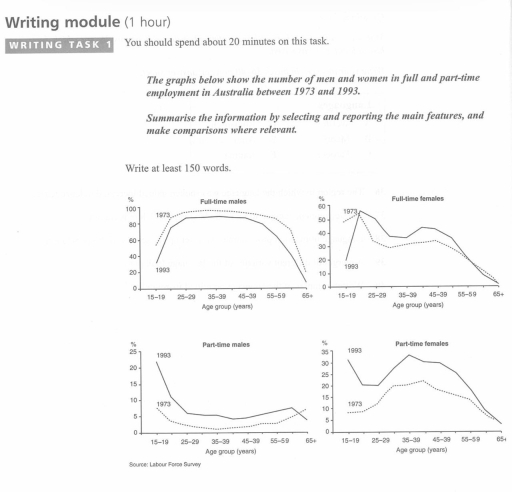
The image consists of four line graphs displaying employment data in Australia across three distinct age groups (15-19, 20-24, 25-29, 30-34, 35-39, 40-44, 45-49, 50-54, 55-59, 60-64, 65+) for 1973 and 1993. Full-time male employment in 1973: 60% (15-19), 90% (20-24), 95% (25-29 to 45-49), 92% (50-54), 88% (55-59), 70% (60-64), 20% (65+); in 1993: 50% (15-19), 81% (20-24), 90% (25-29 to 50-54), 80% (55-59), 60% (60-64), 20% (65+). Full-time female employment in 1973: 50% (15-19), 40% (20-24), 35% (25-29), 30% (30-34), 35% (35-39), 40% (40-44), 35% (45-49), 30% (50-54 to 55-59), 10% (60-64), 0% (65+); in 1993: 40% (15-19), 50% (20-24 to 30-34), 55% (35-39), 60% (40-44), 58% (45-49), 50% (50-54 to 55-59), 20% (60-64), 0% (65+). Part-time male employment in 1973: 5% (15-19), 2% (20-24), 1% (25-29 to 35-39), 2% (40-44), 3% (45-49), 4% (50-54), 8% (55-59), 15% (60-64), 20% (65+); in 1993: 8% (15-19), 5% (20-24), 3% (25-29), 4% (30-34), 3% (35-39), 4% (40-44 to 50-54), 5% (55-59), 15% (60-64), 25% (65+). Part-time female employment in 1973: 5% (15-19), 15% (20-24), 12% (25-29), 10% (30-34), 20% (35-39), 25% (40-44), 28% (45-49), 27% (50-54), 22% (55-59), 20% (60-64), 8% (65+); in 1993: 5% (15-19), 20% (20-24), 25% (25-29), 30% (30-34), 35% (35-39), 42% (40-44), 40% (45-49), 35% (50-54), 25% (55-59), 18% (60-64), 10% (65+).
Given the complexity of the image, the above description may not be entirely accurate.
Skyrocket your IELTS band score by 1-2 points in under a month with our premium plan!
Note: Both the topic and the answer were created by one of our users.
The line graphs highlight the data about the changes in the full-time and part-time employment rates of men and women in Australia over a twenty-year period between 1973 and 1993.
Overall, what stands out from the graph is that there was a significant fall in the number of full-time males in different age groups by approximately 10%, while the amount of part-time males saw a considerable upward over the period. Another noticeable point is that despite the fact that the percentage of part-time employed females in 1993 significantly exceeds the percentage of part-time employed females in 1973, the disparity amounts to approximately 25%.
The trend on the graph showing the data about full-time females is not similar. According to the figures, the number of women with a full-time job in 1973 and 1993 varied significantly. The amount of females from 15-19 accounted for 20% in 1993 was less than in 1973, which which amounted to almost 50%. Until about the age of 20-24, the number of women with a full-time job grew with high rate and leveled of at just its maximum of 55%. By the way, another noticeable point is that it is the total number of full-time employed females at the age of 20-24 in 19993 had achieved the highest result in comparison with all the presented graphs. Then there was a fluctuation, nonetheless the percentage of women working full-time in 1993 slightly overweighed the total number of women with a full day work in 1973 until the age of 55-59, then, the reverse trend began to be observed.
260 words
Word Count: 263
