Our system will evaluate the answer based on this AI-generated description.
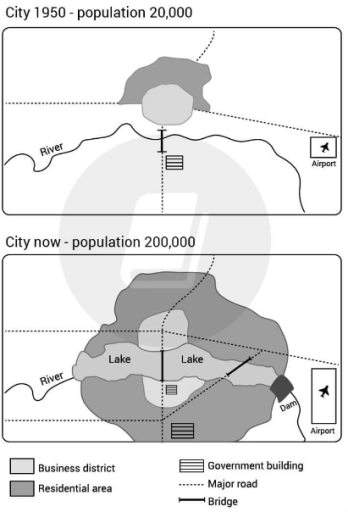
The image consists of two maps illustrating the same city at two different time periods labeled "City 1950 - population 20,000" and "City now - population 200,000". In the 1950 map, the city shows a river running horizontally with a bridge, a business district at the center, residential area spread around it, one major road bisecting the city vertically, and an airport located to the northeast of the city. The current map displays significant expansion with the business district occupying a larger central area, residential areas surrounding it, and two government buildings located in the north and south. The river now features a dam, and there are two lakes within the city limits. The major road network has increased in density, with one still running vertically through the center, and there is a bridge crossing the river. The airport remains in the same location to the northeast.
Given the complexity of the image, the above description may not be entirely accurate.
Skyrocket your IELTS band score by 1-2 points in under a month with our premium plan!
Note: Both the topic and the answer were created by one of our users.
These two maps show the population number as well as the landscape of the city in comparison of 1950 and the present day.
The most critical area being changed is the population is significantly increased 10 times with the figure 20,000 in 1950 to 200,000 now. Accordingly, residential area is almost tenfold increased. A similar trend is that the business district is increased with double size but separated into two parts by a lake. With the construction of the dam, the river nowadays, with collection of water into the lake, is shortened. Further, the airport size is extended to double size. Furthermore, only one government building in 1950, whereas, there are two government building which are small-sized one and large-sized one respectively.
Overall, it is found that the development of city is urbanised with the expansion of population size.
Word Count: 139
