Our system will evaluate the answer based on this AI-generated description.
The image shows a bar chart representing the employment categories of adult population for the years 2003 and 2013. There are seven categories displayed: Education training, Hotel industry, Medical, Building, Business, Self-employed, and Unemployed. In 2003, Education training was around 10%, Hotel industry was slightly above 10%, Medical was around 5%, Building was approximately 40%, Business was slightly above 10%, Self-employed was approximately 17.5%, and Unemployed was slightly above 5%. In 2013, Education training was around 17.5%, Hotel industry was around 15%, Medical was approximately 7.5%, Building was approximately 20%, Business was approximately 32.5%, Self-employed was around 30%, and Unemployed was around 7.5%. There is a notable increase in Business and Self-employed categories, while Building saw a significant decrease from 2003 to 2013.
Given the complexity of the image, the above description may not be entirely accurate.
Skyrocket your IELTS band score by 1-2 points in under a month with our premium plan!
Note: Both the topic and the answer were created by one of our users.
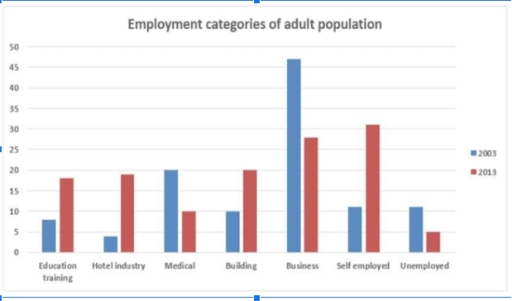
The bar chart illustrates the number of adults working in seven different sectors of jobs in the United States between 2003 and 2013.
Overall, business was the most common employment category in 2003, but by 2013, self-employment had become more popular. While some areas experienced significant growth, others saw a noticeable decline over the ten-year period.
In 2003, nearly half of the adult population was employed in business, but this dropped significantly to around 28% in 2013. The medical field also saw a slight decrease from about 20% to 13%. In contrast, the number of unemployed adults dropped by half, from 12% in 2003 to roughly 6% in 2013.
By 2013, self-employment increased dramatically from 13% to approximately 30%, becoming the second most popular employment type. Employment in education and the hotel industry also rose, with education training increasing from around 8% to 18%, and the hotel sector going from just 5% to about 18%. Similarly, the building industry saw a growth from 10% to 20%.
In summary, while employment in business and medical fields declined, there was a strong increase in self-employment and jobs in education, hotels, and construction.
Word Count: 190
